In modern warehousing and distribution, the selection of a storage medium is not merely a logistical choice but a strategic capital investment that dictates throughput capacity, safety compliance, and long-term operational expenditure. As a structural engineer and B2B content strategist specializing in material handling infrastructure, I have overseen the implementation of high-density storage solutions across automotive, e-commerce, and cold-chain sectors. The foundational decision always revolves around the specific types of racks deployed. Choosing the wrong system results in cubic space waste, increased labor costs, and significant safety hazards. This analysis dissects the mechanical properties, load dynamics, and application-specific engineering behind the primary types of racks, providing a framework for asset managers to calculate true ROI based on structural integrity and inventory velocity.
1. Structural Hierarchy: Categorizing Rack Systems by Load-Bearing Mechanics
Before selecting a specific architecture, one must understand the engineering classifications based on load path and assembly. The industry typically segments these structures into roll-formed (light to medium duty) and structural boltless or bolted systems (heavy-duty seismic applications). Within these classifications, the configuration dictates the inventory management strategy.
1.1 Selective Pallet Racking (SPR): The Benchmark for Accessibility
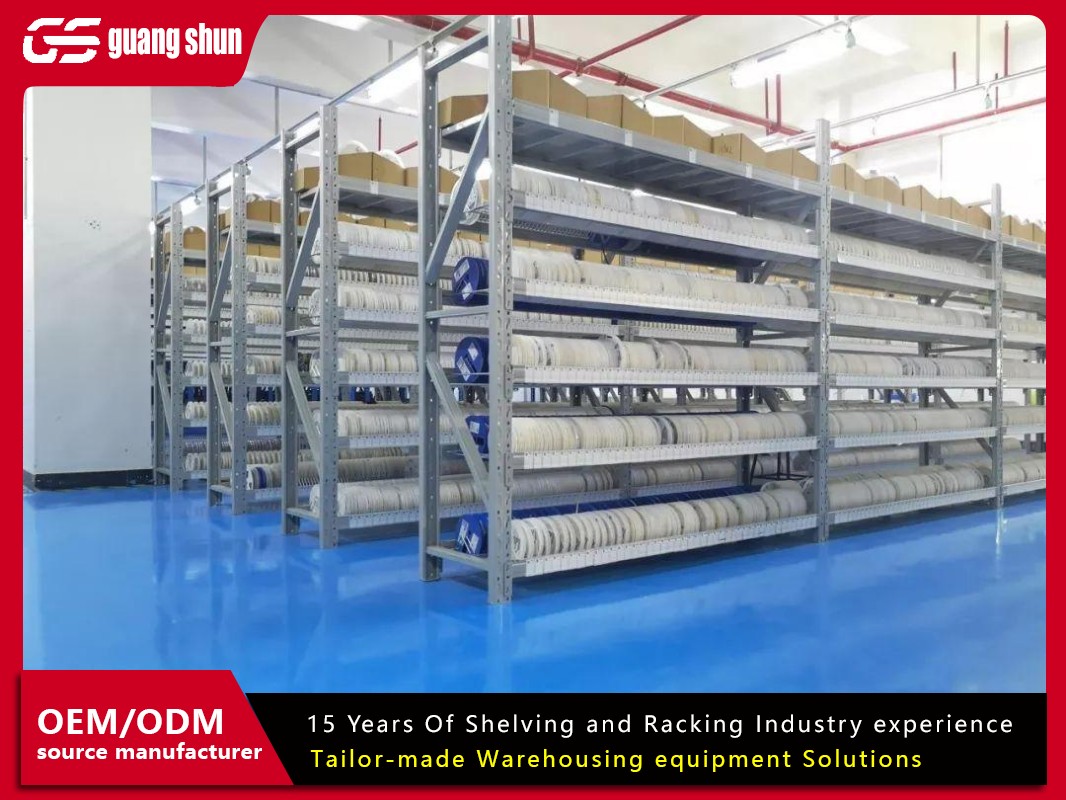
Selective Pallet Racking remains the most prevalent configuration globally, accounting for approximately 65% of industrial warehouse installations. The architecture provides 100% pallet selectivity. From a structural engineering standpoint, the system comprises upright frames (typically 3 to 6 inches wide) connected by horizontal load beams. The critical engineering parameter here is the beam-to-upright connection integrity. At Guangshun, we utilize a triple-rivet, keyhole connection system that ensures static load capacities of up to 2,500 kg per beam level, accommodating diverse SKU variability. The primary limitation is floor space utilization; SPR typically achieves only 30-40% space utilization due to the necessary aisles for counterbalance forklifts, though this is mitigated by very narrow aisle (VNA) truck integration with wire guidance systems.
2. High-Density Configurations: Compressing Cube Utilization
When the operational requirement shifts from immediate access to volumetric efficiency, the selection of types of racks pivots toward continuous run systems. These solutions minimize or eliminate aisles, leveraging Last-In-First-Out (LIFO) or First-In-First-Out (FIFO) flow dynamics.
2.1 Drive-In and Drive-Through Racking: Maximizing Cubic Density
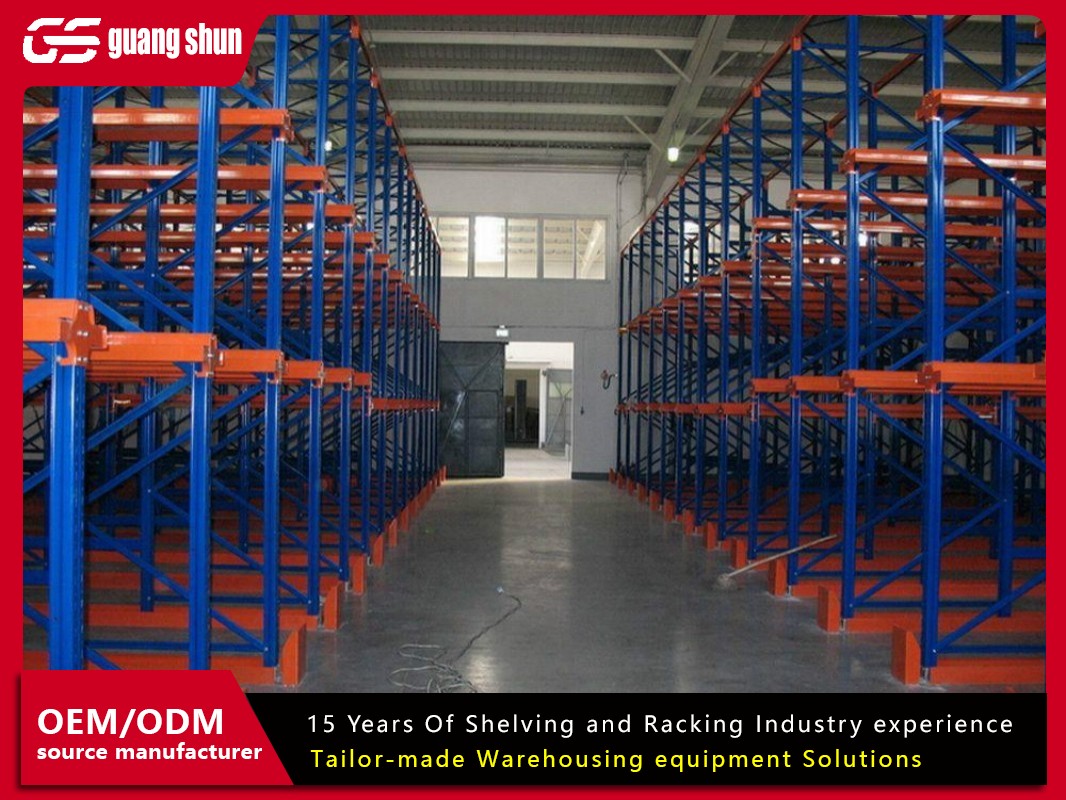
Drive-in racking eliminates aisles entirely, utilizing a continuous rail system where a forklift enters the storage structure. This is engineered for homogeneous, high-volume SKUs with LIFO rotation. The structural challenge involves lateral stability; because the system lacks cross-aisle bracing, heavy-gauge upright protectors and floor anchoring are critical to resist impact forces. Installation requires precision alignment to ensure forklift mast clearance is maintained within millimeters. For cold storage facilities, where energy costs are prohibitive, drive-in systems reduce the cubic volume that requires temperature control by up to 25% compared to selective systems.
2.2 Push-Back Racking: Gravity-Driven Lane Storage
Push-back systems utilize a nested cart mechanism on inclined rails. Each lane typically accommodates 2 to 6 pallets deep. From a mechanical engineering perspective, the system relies on the dynamic coefficient of friction between polyurethane wheels and steel rails. Proper maintenance of the incline angle—typically between 2.5 and 3.5 degrees—is essential to ensure reliable cart return without excessive speed. This configuration offers a higher storage density than selective (approximately 60-70% utilization) while maintaining better SKU segregation than drive-in, making it ideal for perishable goods where batch rotation is managed but immediate single-pallet access is required.
2.3 Pallet Flow (Gravity Flow) Racking: FIFO Optimization
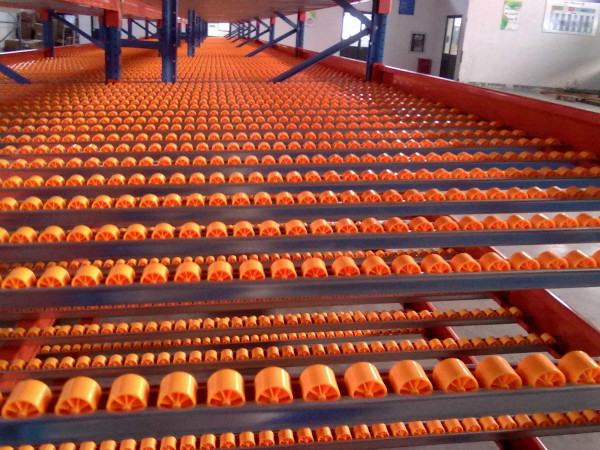
For operations demanding FIFO inventory management—common in food and beverage—pallet flow racking integrates wheel beds or roller tracks with speed controllers. The engineering sophistication lies in the braking systems. Without proper hydraulic or mechanical retarders, pallet momentum increases dangerously as it descends the lane. Modern systems incorporate progressive braking that maintains a controlled descent speed of approximately 0.3 to 0.5 meters per second, preventing impact damage to downstream pallets and structural components. This type of rack is optimal for distribution centers with high SKU turnover rates exceeding 3.5 turns per month.
3. Specialized Systems: Mezzanine Integration and Cantilever Architecture
Beyond traditional pallet storage, specialized types of racks address non-palletized materials and vertical expansion constraints.
3.1 Structural Mezzanine Racking: Multi-Level Industrial Platforms
Mezzanine systems transform airspace into usable floor space. When integrated with standard racking, they create a hybrid structure. Engineering considerations here involve live load ratings (typically 125 PSF for light industrial to 250 PSF for heavy storage) and seismic bracing. The column base plates must be designed to transfer both vertical loads and horizontal shear forces to the existing slab. This configuration is critical for facilities where land expansion is not feasible, effectively doubling the storage footprint without increasing real estate costs.
3.2 Cantilever Racking: Handling Long Loads
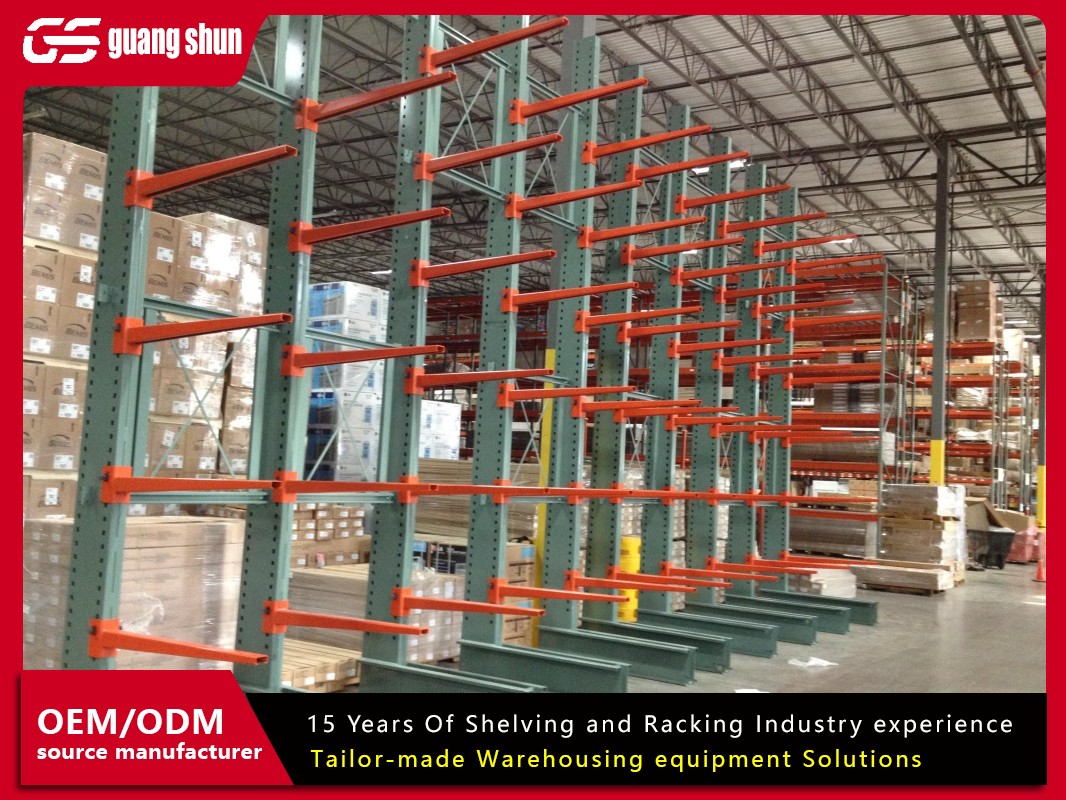
For lumber, piping, steel bars, and furniture, cantilever racking is the definitive solution. The structural design utilizes a single column with extending arms. The critical failure point is the moment connection at the column-arm interface. Arm capacities decrease exponentially as the arm length extends; for a 48-inch arm, capacity might be 1,500 kg, while a 72-inch arm reduces to 600 kg due to leverage mechanics. Proper selection requires precise calculation of load moments rather than just static weight.
4. Addressing Industry Pain Points: Structural Failures and Optimization
The primary industry pain point in material handling is not initial procurement cost, but Total Cost of Ownership (TCO), which is heavily influenced by damage rates and reconfiguration costs. Data from the Material Handling Institute indicates that 30% of racking structures in operation have sustained some level of impact damage that compromises the original safety factor.
Mitigation strategies include:
Column Guard Engineering: Installing sacrificial guard rails or reinforced concrete bollards to absorb impact energy before it reaches the upright frame.
Seismic Base Isolation: In high-seismic zones (Seismic Design Categories D and E), bolted, base-plate anchored systems with moment-resisting frames are mandatory to prevent collapse during lateral movement.
Load Verification Protocols: Implementing digital load indicators and beam-locking safety clips to prevent accidental dislodgement, a leading cause of rack collapse incidents.
To mitigate these risks, Guangshun employs finite element analysis (FEA) for custom configurations, ensuring that the specified types of racks exceed industry safety standards (RMI/ANSI MH16.1) by a margin of 15% in yield strength.
5. Strategic Selection Matrix: Matching Rack Type to Operational KPIs
To simplify the engineering selection process, decision-makers should evaluate three variables: Inventory SKU count, pallet depth, and turnover rate. The following matrix outlines the optimal type of rack based on these metrics:
High SKU Diversity (2,000+), Low Depth, High Turnover: Selective Pallet Racking with VNA technology. (Accessibility: 100%; Density: Low/Moderate).
Medium SKU, Deep Inventory, LIFO Rotation: Drive-In Racking or Push-Back. (Accessibility: Lane-based; Density: High).
Low SKU, Deep Inventory, FIFO Mandate: Pallet Flow Racking. (Accessibility: Lane-based; Density: High; Capital Investment: Highest).
Oversized/Long Goods: Cantilever Racking. (Structural requirement: Moment resistance).
Furthermore, integrating automated storage and retrieval systems (AS/RS) with these static structures transforms them into dynamic systems. However, the foundational selection of the types of racks must accommodate the tolerances required for automated shuttles—typically requiring beam straightness tolerances within +/- 1.5mm over 12-meter spans, a precision metric that differentiates high-grade manufacturers from commodity suppliers.
6. Economic Analysis: Depreciation, Safety, and Scalability
From a financial perspective, racking systems are classified as 7-year property under MACRS (Modified Accelerated Cost Recovery System) in North America. However, high-quality structural systems often have a functional lifespan exceeding 20 years if properly maintained. The critical economic factor is scalability. Modular systems, particularly those utilizing standard upright frames with adjustable beam levels, offer the lowest reconfiguration costs. When a facility undergoes SKU rationalization or SKU proliferation, the ability to relocate beams without welding or specialized tools reduces changeover costs by an estimated 40% compared to welded or fixed-frame alternatives.
Safety compliance also presents a direct financial impact. Non-compliance with OSHA 1910.176 (handling materials) or local seismic codes can result in penalties exceeding $15,000 per violation. Investing in engineered systems with certified load capacities mitigates this liability.
Frequently Asked Questions (FAQs)
Q1: What is the maximum height I can achieve with standard industrial racking without requiring seismic retrofitting?
A1: The height threshold varies by seismic zone. In Seismic Zone 0-1 (low risk), rack heights up to 40 feet are common with standard anchoring. In Seismic Zone 4 (high risk), any structure exceeding 8 feet in height typically requires engineering calculations for lateral bracing. Most jurisdictions mandate engineered stamped drawings for structures exceeding 15 feet to ensure compliance with IBC (International Building Code) regulations. Always consult a structural engineer to evaluate your specific slab thickness and soil conditions.
Q2: How do I calculate the true load capacity for a drive-in rack system versus a selective system?
A2: Load capacity in selective systems is determined by the beam capacity (uniform distributed load) and the frame capacity (axial load). For drive-in systems, the calculation is more complex as it involves the rail capacity per pallet position and the upright capacity based on the number of rails supported. A common engineering rule is that for drive-in racks, the upright capacity is reduced by 20-25% compared to selective due to the eccentric loading from rails. You must always request a certified load chart from the manufacturer specifying the capacity per beam level, per upright, and per rail position.
Q3: Can I integrate automated guided vehicles (AGVs) with all types of racks, or are there specific requirements?
A3: AGV integration requires extremely tight tolerances. For selective racks, the floor flatness must meet F-min (F-number) standards (typically Fmin 50-75). The upright placement tolerance must be within +/- 5mm to ensure AGV laser guidance systems can navigate consistently. For flow racks, the integration of pallet stops and sensors must be wired into the warehouse control system (WCS). Not all manufacturers produce racking with the necessary straightness and alignment tolerances for automation; it requires a supplier that specializes in automation-ready structural steel.
Q4: What are the specific fire safety requirements for high-density storage systems like drive-in or pallet flow?
A4: High-density storage significantly alters fire dynamics. NFPA 13 (National Fire Protection Association) mandates specific sprinkler design requirements for racks exceeding 12 feet in height. For drive-in racks, in-rack sprinklers are often mandatory because the solid storage blocks ceiling sprinkler penetration. There are strict limitations on flue spaces (transverse and longitudinal) that must be maintained—typically 6 inches for transverse flues and 4-6 feet for longitudinal aisles. Failure to maintain these flue spaces can invalidate insurance coverage and increase fire risk exponentially.
Q5: How does the gauge of steel (e.g., 16-gauge vs. 12-gauge) impact the long-term durability of the rack?
A5: Steel gauge directly correlates to impact resistance and structural integrity. 16-gauge steel (approx. 1.5mm) is common for light-duty, roll-formed systems used in retail or static storage. For heavy-duty industrial applications subjected to daily forklift traffic, 12-gauge (approx. 2.6mm) or 10-gauge (3.4mm) structural steel is required. Thicker steel provides a higher section modulus, meaning better resistance to bending from impacts. While thicker steel increases upfront capital expenditure by approximately 18-25%, it reduces maintenance costs and extends service life by a factor of 2 to 3 times compared to lighter-gauge alternatives.
For comprehensive engineering specifications and load capacity charts tailored to your facility’s seismic zone and throughput requirements, consult the engineering team at Guangshun. Their analysis ensures that the selected types of racks deliver optimal ROI over a 20-year lifecycle.