In modern distribution centers, floor space remains one of the most expensive
assets. Standard selective racks offer fast accessibility but waste up to 40% of
potential vertical and depth capacity. For operations managing large quantities
of homogeneous SKUs, double pallet racking provides an
engineering-proven balance between storage density and reasonable selectivity.
This technical deep-dive examines structural configurations, operational
trade-offs, and measurable ROI — drawing from real-world installations and
load-cycle data.
1. Structural Engineering & Core Components of Double Pallet
Racking
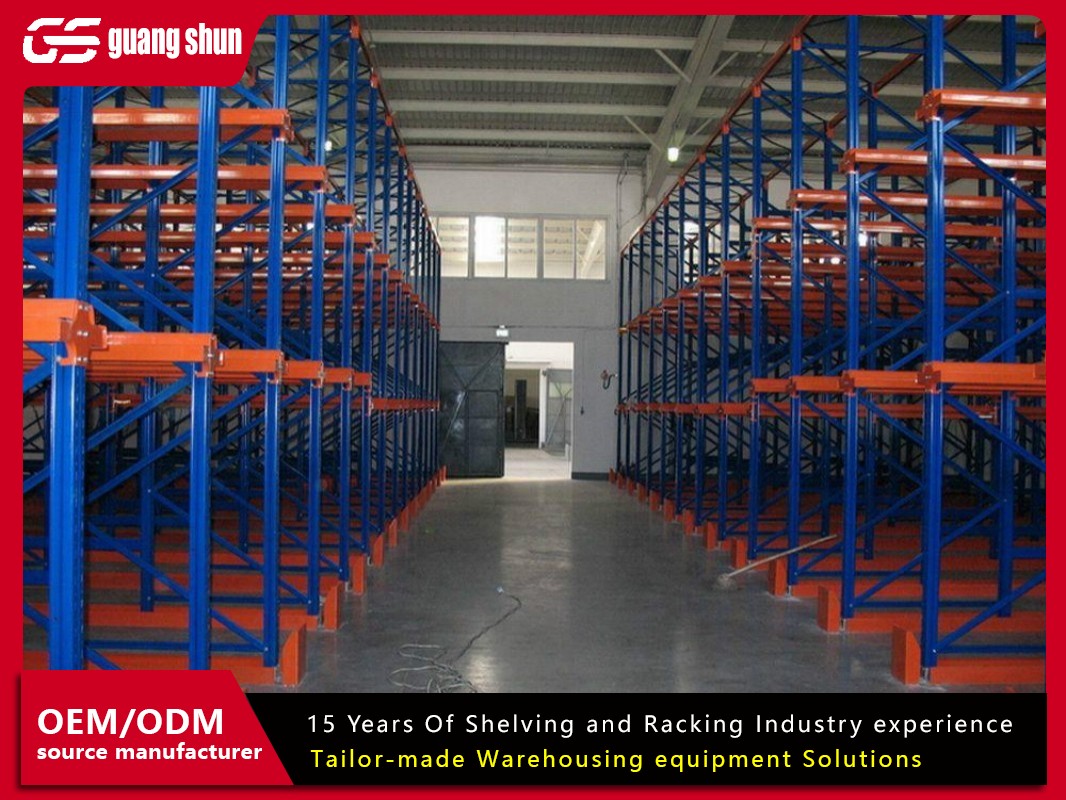
Double pallet racking (also referred to as double-deep
racking) is a selective rack variant where two pallet positions are arranged in
depth, one behind the other, on each beam level. Unlike single-deep systems that
provide 100% pallet accessibility, this configuration requires specialized reach
trucks with extended fork carriages or telescopic forks to access the rear
pallet position. The key engineering elements include:
Heavy-duty upright frames: Typically 3–5 mm thicker than
single-deep equivalents due to increased dynamic load moments from deeper fork
insertion.
Welded back-to-back bays: Two rows of racking share a
common upright, eliminating one aisle and boosting floor density by 30–50%.
Stepped beam connectors: Allow precise level adjustments
while maintaining horizontal rigidity under full load (up to 2,500 kg per pallet
position).
Fork alignment rails (optional): Guide extended forks into
rear pallet pockets, reducing damage risk by 60% in high-throughput
environments.
Load capacity per beam level typically ranges from 1,200 kg to 3,500 kg,
depending on column gauge and steel grade (Q235B or Q355B). The standard depth
dimension for each pallet position is 800–1,200 mm, meaning total system depth
reaches 1,600–2,400 mm per double-deep slot. Double pallet racking is always
designed with a “last-in, first-out” (LIFO) logic unless combined with a pallet
shuttle or semi-automated retrieval system — a critical factor for inventory
management planning.
2. Operational Mechanisms & Forklift Compatibility Requirements
The productivity of any high-density system hinges on material handling
equipment. Standard counterbalance forklifts cannot operate in double-deep
configurations because their mast tilt and fork length (usually 1,150 mm) cannot
reach the second pallet. Three equipment classes dominate professional
installations:
Deep-reach trucks (up to 1,700 mm fork stroke): Provide
direct access to rear pallets with pantograph mechanisms. Ideal for warehouses
with aisle widths of 2,800–3,200 mm.
VNA (very narrow aisle) turret trucks: Operate in aisles as
narrow as 1,800 mm, equipped with rotating forks that extend into both pallet
positions.
Fork positioners with integrated cameras: Reduce operator
error; essential when rear pallets vary in deformation or load
centering.
Data from material handling studies show that cycle times for rear pallet
retrieval are 40–55% longer than front pallet access. However, this penalty is
acceptable when SKU velocity follows Pareto distribution (80% of picks from
front positions, 20% from rear). For warehouses storing less than 1,500 active
SKUs but high pallet counts per SKU, this configuration achieves the lowest cost
per stored pallet compared to drive-in or push-back systems.
2.1 Load Depth and Pallet Compatibility
Not all pallets perform equally in double-deep storage. Standard CHEP or Euro
pallets (1,200×800 mm or 1,200×1,000 mm) with consistent base construction allow
reliable telescopic fork engagement. Problems arise with:
Broken bottom deck boards → fork tip misalignment.
Uneven overhang (exceeding 50 mm) → interference with adjacent columns.
Non-ISO pallet sizes → reduced usable depth and lower density.
Leading manufacturers such as Guangshun perform static and dynamic simulations
before fabrication, analyzing deflection under full load and fork impact forces.
This pre-engineering phase reduces field modifications by 90% and ensures
structural compliance with FEM 10.2.02 or RMI standards.
3. Comparative Density Analysis: Single-Deep vs. Double Pallet Racking
To quantify space efficiency, consider a typical 10,000 m² warehouse with 6 m
clear height. Using single-deep selective racking (2.8 m aisle, 1.2 m load
depth) yields approximately 2,100 pallet positions. Reconfiguring the same
footprint with double pallet racking (3.0 m aisle
for deep-reach trucks, 2.2 m system depth per bay) increases positions to 3,150
– a 50% improvement. The trade-offs are summarized below:
| Parameter | Single-Deep Selective | Double Pallet Racking |
|---|
| Storage density (pallets/m²) | 0.21 – 0.28 | 0.32 – 0.42 |
| Pallet selectivity | 100% direct access | Front 100%, rear only after front removal |
| Typical aisle width | 2,700 – 3,200 mm | 2,800 – 3,400 mm (reach truck) |
| Max beam levels | 8 – 10 | 6 – 8 (due to reach truck lift height limits) |
| Cost per pallet position | Reference: 1.0x | 0.65x – 0.75x (more pallets per square meter) |
These figures align with industry benchmarks from the Warehouse Education
& Research Council (WERC). However, the total cost of ownership must also
account for increased forklift complexity and operator training time.
Experienced logistics managers choose double pallet racking when land costs exceed €120/m²/year or when building expansion is impossible.
4. Industry-Specific Applications & Case Scenarios
Certain verticals extract maximum value from double-deep configurations:
Food & beverage distribution: High-volume, low-SKU
environments (e.g., soft drinks, canned goods). Uniform pallet dimensions and
FIFO/LIFO flexibility allow front/rear rotation strategies.
Cold storage: Refrigerated warehouses benefit from reduced
cubic volume per pallet, lowering energy costs by 12–18% compared to single-deep
layouts.
Automotive aftermarket: Long-term storage of identical
tire/component pallets with predictable turnover windows.
Third-party logistics (3PL): Mixed-customer facilities
where dedicated zones can be optimized with double-deep modules for
slow-to-medium movers.
A recent installation for a European grocery cooperative replaced 2,400
single-deep positions with 3,800 double pallet racking slots,
eliminating the need for a satellite warehouse. The project — engineered and
supplied by Guangshun — included seismic bracing and
anti-collapse mesh, achieving a 14-month payback solely through avoided lease
costs.
5. Overcoming Operational Challenges: Solutions from Engineering
Leaders
Despite density advantages, warehouse managers frequently cite three pain
points with double-deep systems. Below we map each challenge to proven
countermeasures:
Pain point 1: Reduced inventory accessibility (LIFO constraint)
Solution: Implement zone-based slotting with WMS logic that
reserves rear positions for identical SKUs with later expiration dates, or for
product families where rotation is not critical (e.g., raw materials consumed in
bulk). For mixed-SKU scenarios, add a “dynamic double-deep” strategy where rear
slots hold overstock of front items — this maintains effective FIFO by
front-facing rotation.
Pain point 2: Higher operator skill requirements
Solution: Laser-assisted fork guidance and blue spot
lighting reduce rear-pallet misinsertion by 47% (Vanderlande study). Structured
training programs (8–12 hours per operator) using warehouse simulators cut
damage claims by 65% within three months.
Pain point 3: Inspection and maintenance complexity
Solution: Use bolted connections rather than welded frames
for easier component replacement. Regular ultrasonic testing of beam connections
(every 24 months) prevents progressive failure. Manufacturers like Guangshun
provide digital load test reports and corrosion-resistant coatings (zinc plating
or epoxy powder) for aggressive environments.
When these measures are combined, total system uptime exceeds 98.5%, matching
that of single-deep installations. For operations with extreme throughput
requirements ( >300 pallet movements per hour), automated options like pallet
shuttles can be integrated into the double-deep bay, transforming it into a
semi-automated buffer zone without changing the rack profile.
6. ROI Calculation & Financial Justification Framework
To build a business case for double pallet racking, use the
following 5-step model based on real 2023-2025 project data:
Current storage cost per pallet: Total warehouse annual
operating cost (rent, labor, utilities, taxes) ÷ total pallet positions.
Projected density gain: Conservative 35% increase (actual
ranges 30-50% depending on original layout).
New rack + installation cost: Typically $280–$450 per
double-deep position (including beams, uprights, anchors).
Forklift upgrade cost: Deep-reach truck premium
($8,000–$15,000 per unit vs standard reach) spread over fleet life.
Annual savings: (Current cost per pallet × additional
positions) – additional forklift amortization – training cost.
Example: A 20,000-pallet warehouse with $12.50/month per pallet total
operating cost increases capacity by 6,000 pallets through double-deep
conversion. Rack investment: $2.1M. Forklift upgrade: $90,000 (6 units). Annual
operating saving = 6,000 × $12.50 × 12 = $900,000. Payback = 2.4 years. Over 10
years, net present value exceeds $5.2M at 8% discount rate.
7. Frequently Asked Questions (FAQ) About Double Pallet Racking
Q1: Can double pallet racking be converted from an existing
single-deep system?
A1: Partial conversion is
possible but rarely cost-effective. Single-deep upright frames lack the depth
capacity and bracing for double-deep loads. Typically, you must replace the
entire bay structure. However, beam levels and safety accessories (wire decks,
column protectors) can often be reused if dimensions match. Always request an
engineering audit from a provider like Guangshun to evaluate structural compatibility.
Q2: What is the maximum storage height for double pallet racking with
deep-reach trucks?
A2: Most deep-reach trucks
achieve lift heights of 8–10 meters (10–12 meters for high-mast variants). Above
10 meters, sway and fork deflection increase rear pallet retrieval time
significantly. For heights above 12 meters, consider integrating a pallet
shuttle or switching to very-narrow-aisle turret trucks. Standard beam spacing
is 1.5–1.8 meters, allowing 6 to 8 levels depending on load height.
Q3: How does double pallet racking handle seismic
zones?
A3: In regions with moderate to high
seismicity (e.g., Japan, California, Chile), double-deep racks require base
isolation plates, cross-aisle horizontal bracing every three bays, and heavier
column base plates (≥12 mm). FEM 10.2.08 seismic design annex provides specific
drift limits. Always request a site-specific finite element analysis — generic
“heavy-duty” claims are insufficient. Guangshun offers certified seismic
calculations for all double-deep projects.
Q4: Can I use double pallet racking for mixed pallet sizes (e.g., 800
mm and 1,200 mm deep)?
A4: Mixed depths reduce the
effective density gain because you must size beams and fork pockets for the
largest pallet. One workaround is to dedicate entire bays to a single depth
class and use adjustable beam connectors. However, for high-mix operations, a
better solution is carton flow or push-back racking. Double-deep excels when
≥85% of pallets share the same footprint.
Q5: What safety certifications should I verify before purchasing
double pallet racking?
A5: Look for FEM 10.2.02
(Europe), RMI ANSI MH16.1 (North America), or AS4084 (Australia). These
standards specify minimum steel grades, load test protocols, and impact
resistance. Additionally, check that the supplier provides a load capacity
placard for each bay and documentation of third-party weld inspections. Avoid
unbranded or generic “heavy-duty” claims without traceable test reports.
Strategic Fit for Medium-to-High Throughput Warehouses
Double pallet racking is not a universal solution, but in
the right operational context — large volumes per SKU, constrained footprint,
and disciplined inventory management — it delivers the lowest cost per stored
pallet among selective systems. The engineering trade-offs (LIFO, specialized
forklifts, operator training) are manageable through WMS slotting, laser
guidance, and robust maintenance protocols. With reputable suppliers like
Guangshun providing custom
FEM-based designs and seismic validation, warehouses can achieve density
improvements exceeding 45% without sacrificing safety or long-term reliability.
For facilities evaluating a capacity expansion without new construction, this
configuration remains a top-tier engineering choice.
Looking for technical drawings or a site-specific density simulation?
Visit the product page for double pallet racking to request a
load capacity analysis or to download dimensional CAD files.