For warehouse operators facing the perpetual challenge of maximizing storage
capacity without expanding their physical footprint, the choice of storage
medium is critical. Double deep pallet racking offers a proven
engineering solution that bridges the gap between the complete accessibility of
selective racking and the ultra-high density of drive-in systems. By storing
pallets two units deep, this configuration effectively doubles storage depth per
lane while maintaining a structured, organized inventory environment.
1. Core Engineering Principles and Structural Mechanics
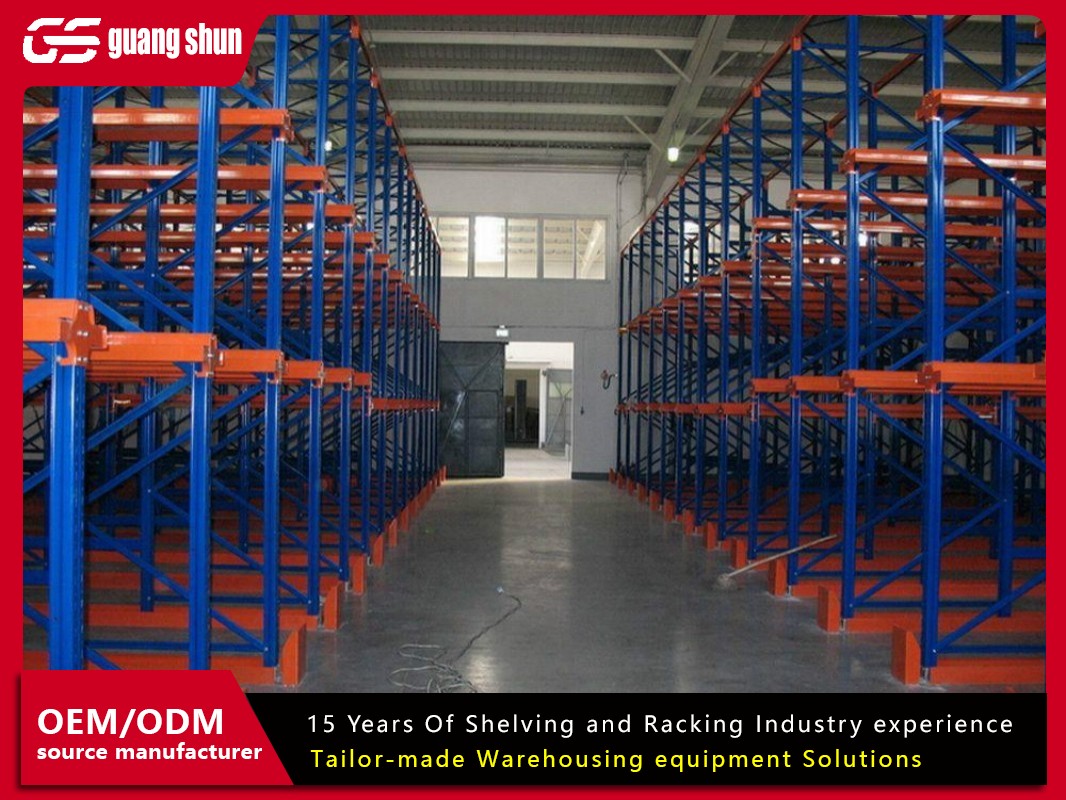
At its foundation, a double deep pallet racking system
modifies the standard selective rack footprint. Instead of a single row of
pallets accessible from an aisle, the system uses extended-depth beams and
specialized upright frames to accommodate two pallets placed end-to-end. This
seemingly simple geometric change necessitates significant engineering
considerations.
The structural integrity relies on precise load distribution. The rear beam
level must support not only the static weight of its own pallet but also bear
the dynamic loads transferred during the insertion and retrieval of the front
pallet. Key structural specifications, such as those offered by manufacturers
like Guangshun, include:
Upright Frame Depth: Typically ranging from 900mm to
1200mm, designed to securely hold two pallets (e.g., two 1000mm deep pallets)
plus necessary clearance.
Beam Profiles: Heavy-duty step beams, often 100mm to 150mm
in height, with a load capacity per beam pair ranging from 2,000 kg to over
5,000 kg, depending on steel gauge and span.
System Bracing: Enhanced horizontal and diagonal bracing
within the upright frames to resist the increased torsional forces from deeper
loads and reach truck operation.
Pallet Supports: Longitudinal support bars or wire mesh
decking are critical to prevent the rear pallet from tipping or sagging into the
front pallet's space.
The use of high-tensile steel, often hot-rolled for the uprights and
cold-rolled for the beams, ensures that the system maintains its rigidity and
resistance to impact over decades of use.
2. Operational Dynamics: The Role of Specialized Handling Equipment
The defining operational characteristic of double deep pallet
racking is the requirement for reach mechanisms capable of accessing
the second storage position. This is not achievable with standard counterbalance
or basic reach trucks.
2.1 Double-Reach Trucks: The Standard Solution
The most common equipment paired with this racking type is the double-reach
truck, also known as a deep-reach or pantograph truck. These vehicles are fitted
with a specialized fork carriage mechanism that extends in two stages—first to
reach the front pallet, and then a second, deeper extension to place or retrieve
the rear pallet. This operation requires:
Controlled Aisle Widths: Typically 2.8 meters to 3.3
meters, which is wider than a single-selective aisle but narrower than a
standard counterbalance aisle. This space allows for the truck's mast to tilt
and the pantograph to extend safely.
Operator Precision: The extended reach magnifies any small
movements at the base, demanding skilled operators and often wire guidance
systems to maintain precise alignment with the rack structure.
Stability Considerations: The load moment increases
significantly when the forks are fully extended. Double-reach trucks are
designed with counterweights and stable bases to handle this, but adherence to
rated capacities is paramount.
2.2 VNA as an Alternative
For facilities with very high throughput demands, Very Narrow Aisle (VNA)
turret trucks can sometimes be adapted for double-deep storage, though this is
less common. This configuration uses rail-guided trucks that can rotate forks
180 degrees to access both sides of the aisle, but the depth of storage remains
two pallets.
3. Strategic Advantages in Inventory Management
While the system imposes a Last-In, First-Out (LIFO) inventory rotation for
each two-deep lane, it offers distinct operational advantages over other
high-density methods. The structured nature of the racking, with defined beam
levels and bay positions, facilitates better integration with Warehouse
Management Systems (WMS).
Compared to drive-in racking, where forklifts enter the storage structure,
double deep configurations offer:
Reduced Product Damage: The rack structure protects each
pallet position, eliminating the risk of a forklift colliding with stored goods
within a deep tunnel.
Improved Selectivity: While not 100%, any pallet stored in
a front position is directly accessible. For SKUs with moderate velocity, front
positions can be allocated for fast movers, while slower-moving stock or reserve
inventory occupies the rear.
Simplified Stock Counting: Each pallet is visible and its
position is physically defined by beams, making cycle counting and physical
inventory verification more straightforward than in block-stacking or drive-in
environments.
4. Quantifying Density Gains and Space Utilization
The primary driver for adopting this racking type is the tangible increase in
pallet positions within a fixed warehouse footprint. A detailed comparison
illustrates this:
Selective Racking: Uses 1 aisle for every 1 row of racks.
Storage depth is 1 pallet. Aisle-to-storage ratio is approximately 40:60.
Double Deep Racking: Uses 1 aisle to serve 2 rows of racks
(back-to-back on each side). Storage depth is 2 pallets. This can increase
storage density by 30% to 60% compared to selective, depending on bay sizes and
aisle widths.
Drive-In Racking: Uses 1 aisle to serve a deep lane of 4-10
pallets. Density is higher, but accessibility is far lower.
For a warehouse with 1,000 square meters of floor space, converting from
selective to double deep can potentially add hundreds of pallet locations,
effectively deferring or eliminating the need for a building expansion. This
makes it a financially attractive option, particularly in facilities where real
estate costs are high, such as cold storage or urban distribution centers.
5. Application Suitability and Product Profiling
The decision to implement this system should be driven by a granular analysis
of the Stock Keeping Unit (SKU) profile. It performs optimally when applied
to:
High-Volume, Low-SKU Products: Ideal for raw materials,
bulk commodities, or finished goods with predictable demand patterns. Allocating
entire lanes to a single SKU simplifies management.
Cold Storage Environments: The density gains directly
reduce the refrigerated volume that must be maintained, offering significant
energy cost savings over the system's lifecycle. The robust steel construction
also withstands the thermal cycling of cold stores.
Seasonal or Safety Stock: Inventory that is held for longer
periods and accessed infrequently is perfectly suited for the rear positions,
freeing up front-line selective space for dynamic SKUs.
A thorough load capacity analysis is essential. Consulting with engineering
teams, such as those at Guangshun, ensures the specified beam lengths and
upright gauges are matched to the actual pallet weights and the operational
frequency of the double-reach trucks.
6. Safety Protocols and Long-Term Maintenance
Sustaining the safety and ROI of a double deep pallet
racking system requires a proactive maintenance regime. The deeper
configuration means that damage to a front beam can compromise the stability of
both stored pallets.
Critical inspection points include:
Beam Lock Integrity: Verify that all safety clips are
present and that beam connectors are fully engaged with the upright slots.
Upright Damage: Inspect the front uprights, especially at
the base, for impact damage from reach trucks. Any deviation from vertical
should be assessed by a structural engineer.
Floor Anchoring: Confirm that all baseplates are securely
fastened to the warehouse floor with the specified grade and type of expansion
anchors.
Pallet Position Clearance: Maintain recommended flue spaces
between the back of the rear pallet and the upright, as well as between the
front pallet and the aisle, to ensure safe forklift access and compliance with
fire codes.
Operator training is equally vital. Drivers must be trained not only on the
mechanics of the double-reach truck but also on the visual cues for correct
pallet placement to avoid over-penetration or under-placement, which can lead to
falls.
7. Comparative Analysis with Other High-Density Systems
To frame its value proposition, it is useful to position double deep
pallet racking against alternatives:
Push-Back Racking: Both offer LIFO and high density.
Push-back uses nested carts on a slight incline, offering potentially faster
cycle times for high-volume picking of individual SKUs, but at a higher cost per
pallet position. Double deep is mechanically simpler and generally more
cost-effective.
Pallet Flow Racking: This gravity-fed system offers FIFO
(First-In, First-Out), making it ideal for perishables, but it requires precise
pallet quality and is more expensive. Double deep is better suited for
non-perishable, uniform loads.
Drive-In Racking: Provides maximum density for very deep
storage of homogeneous products but suffers from poor selectivity and higher
damage risk. Double deep offers a balance, with every pallet position
structurally protected.
The optimal choice often involves a hybrid approach, using double deep
racking for the bulk of inventory and selective or flow racking for fast-moving
or mixed-SKU picking zones.
Frequently Asked Questions
Q1: What is the fundamental difference between double deep and single
selective pallet racking?
A1: Single selective racking stores
pallets one deep, offering 100% direct access to every pallet from the aisle.
Double deep pallet racking stores pallets two deep, requiring a
double-reach forklift to access the second pallet, but significantly increases
storage density within the same floor space.
Q2: What type of forklift is absolutely required for a double deep
system?
A2: You need a specialized forklift with a reach mechanism
that extends in two stages, commonly called a double-reach truck or deep-reach
truck. Standard reach trucks or counterbalance forklifts cannot safely or
effectively access the second row of pallets in this configuration.
Q3: Does double deep racking follow FIFO or LIFO inventory
rotation?
A3: It operates strictly on a LIFO (Last-In, First-Out)
basis for each individual two-deep lane. The front pallet must be removed to
access the pallet stored behind it. This makes it best suited for non-perishable
goods or products where stock rotation is not a primary requirement.
Q4: How much more storage space can I expect from switching to double
deep racking?
A4: Density gains are project-specific, but you can
typically achieve a 30% to 60% increase in pallet positions compared to a
standard selective layout. The exact gain depends on factors like your current
aisle widths, bay sizes, and pallet dimensions. An engineering audit can provide
a precise calculation.
Q5: What are the typical load capacity ranges for beams in this
system?
A5: Beam capacities are highly customizable based on the
steel profile and thickness. Common heavy-duty specifications support between
2,000 kg and 5,000 kg per beam pair. For precise requirements, you must consult
manufacturer specifications, such as those provided by Guangshun, to match
the beam to your specific pallet and load weights.
Q6: Is double deep racking suitable for a cold storage
warehouse?
A6: Yes, it is exceptionally well-suited for cold
storage. The high storage density reduces the total refrigerated space required,
leading to significant energy savings. The steel used must be specified with
appropriate corrosion-resistant coatings to handle the temperature and humidity
conditions.
Q7: Can the system be configured to handle different pallet sizes in
the same bay?
A7: While it is possible, it is generally not
recommended. For operational efficiency and safety, each lane should be
dedicated to a consistent pallet size. Mixed sizes can complicate the reach
truck operation and increase the risk of misplacement or load instability. The
system is designed for uniform pallet profiles.