In modern distribution centers and manufacturing facilities, the selection
and engineering of warehouse
racking systems directly determine operational throughput, safety
margins, and capital expenditure efficiency. As supply chains demand higher
storage densities and faster inventory turns, conventional shelving no longer
suffices. This article examines the technical parameters, structural dynamics,
and integration strategies that define high-performance warehouse
racking infrastructure, drawing on engineering standards and real-world
applications. We will explore how material science, finite element analysis, and
automation compatibility converge to create storage ecosystems that maximize
cubic utilization while maintaining absolute structural integrity.

1. The Structural Imperative: Beyond Basic Load Capacity
While load capacity remains the primary specification for any
warehouse racking system, experienced facility planners
understand that static weight ratings tell only part of the story. The true
engineering challenge lies in dynamic load distribution, seismic force
dissipation, and long-term fatigue resistance. Modern warehouse
racking structures must comply with international standards such as
AS4084 (Australia), SEMA (Europe), and RMI (North America), but compliance alone
does not guarantee operational resilience.
1.1 Finite Element Analysis in Racking Design
Advanced manufacturers employ Finite Element Analysis (FEA) to simulate
stress concentrations, beam deflection under eccentric loads, and column
buckling thresholds. For instance, selective pallet racking systems—the most
common configuration—require precise calculations of upright frame gauge,
horizontal bracing spacing, and footplate anchoring. A single overloaded beam
can cascade into a catastrophic collapse. Industry data indicates that over 60%
of racking failures originate from inadequate anchor bolt specifications or
deteriorated floor substrates, not the rack components themselves. Therefore,
comprehensive site surveys must include concrete strength testing (minimum 3,000
psi for standard applications) and anchor pull-out verification.
1.2 Seismic Design Categories and Structural Reinforcement
Facilities located in regions with high seismic activity demand specialized
engineering. In Seismic Design Category (SDC) D and E zones, warehouse
racking systems must incorporate base isolation systems, oversized
column base plates, and continuous tie beams. The 2019 Ridgecrest earthquakes in
California demonstrated that unbraced drive-in racking suffered disproportionate
damage compared to seismically qualified selective systems. To mitigate this,
engineers now specify row spacers, roof connectors, and cross-aisle seismic
separators. Guangshun integrates
seismic-optimized connectors in their structural steel designs, ensuring
compliance with IBC 2021 and CBC standards while maintaining beam-to-column
connection rigidity.
2. Application-Specific Configurations: Matching Racking to Operational
Profiles
No single warehouse racking topology serves all storage
needs. The choice between selective, double-deep, drive-in, push-back, or pallet
flow systems depends on SKU velocity, inventory depth, and floor space
economics. Below is a technical breakdown of dominant architectures.
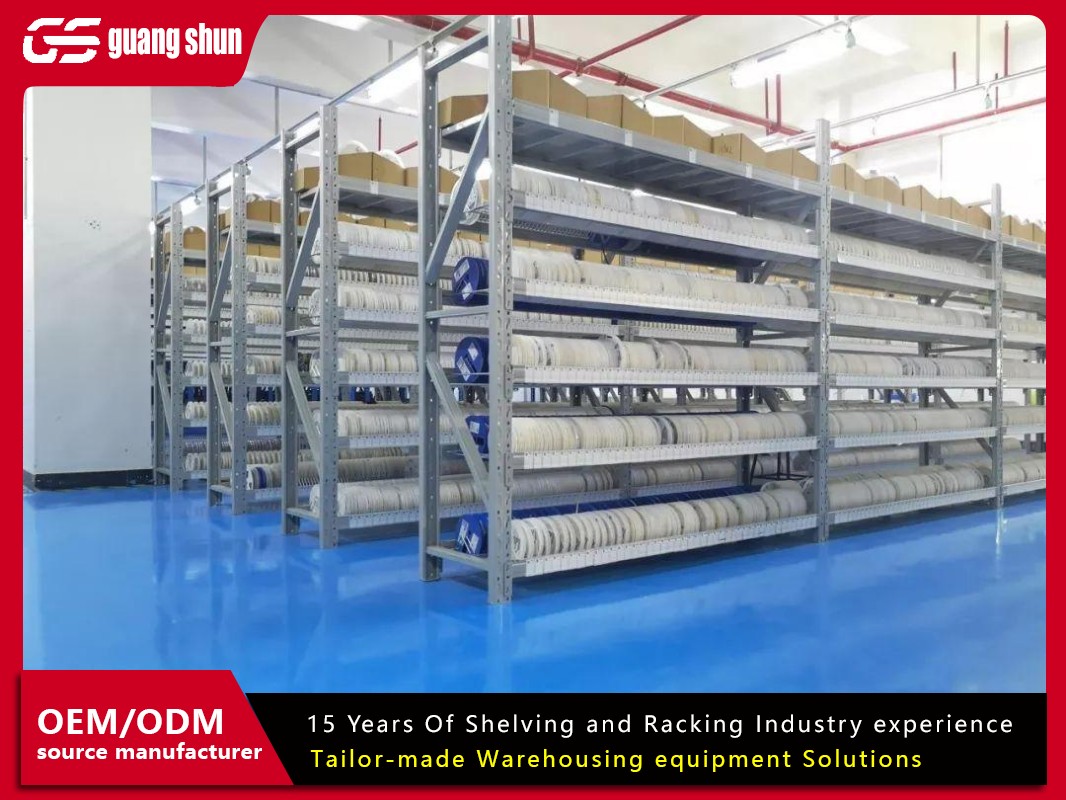
Selective Pallet Racking: Offers 100% pallet accessibility.
Ideal for SKU-intensive operations with high turnover. Typical load capacities
range from 2,500 to 6,000 lbs per beam level. Upright frame spacing is
calculated based on pallet dimensions and forklift maneuvering clearances
(minimum 3.5m aisles for counterbalance trucks).
Double-Deep Racking: Increases storage density by up to 40%
over selective, but requires reach trucks or swing-mast forklifts. Beam depths
extend to accommodate two pallets deep. Critical design factor: beam deflection
under double-pallet depth loads must remain within L/180 to prevent load
dislodgment.
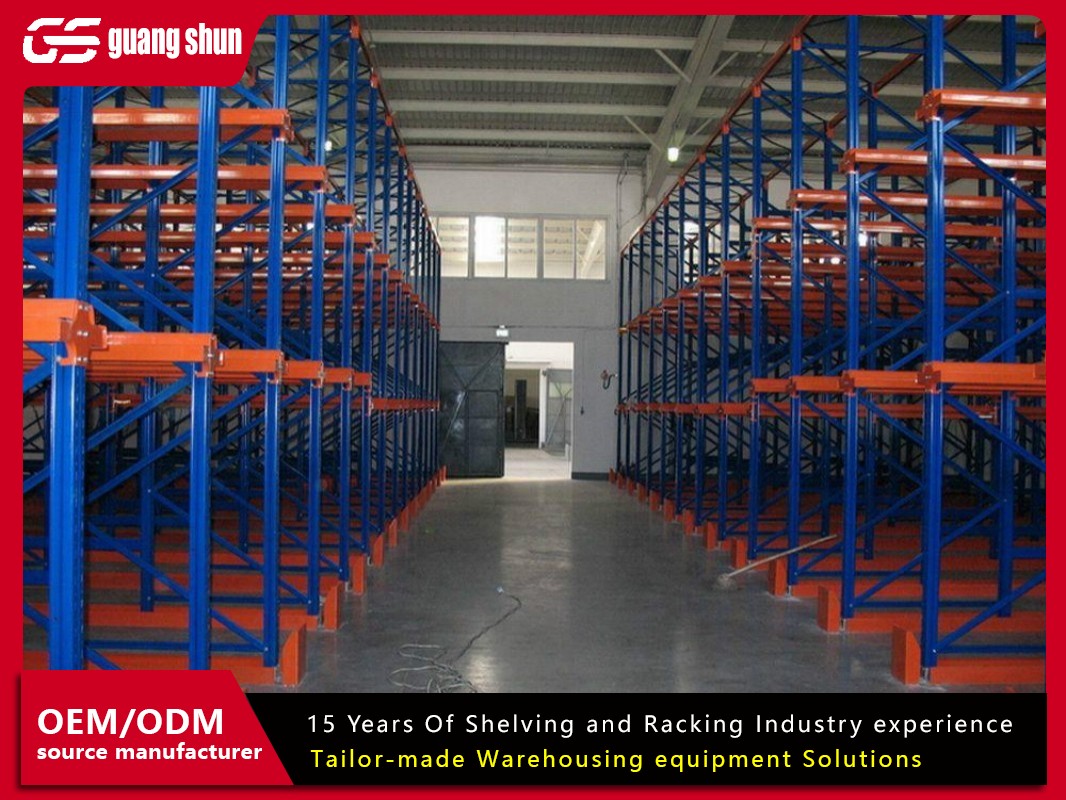
Drive-In/Drive-Through Racking: Maximizes density for
homogeneous products (LIFO). Structural challenges include lateral stability
during forklift entry. Engineers must specify heavier upright frames (3.0mm to
4.0mm steel thickness) and full-height back-to-back bracing. Column protection
(corner guards) is mandatory to prevent impact damage.
Pallet Flow Racking: Combines gravity-fed lanes with FIFO
inventory rotation. Requires precise lane inclination (typically 3.5% to 5%) and
wheel bed or roller track systems with controlled speed brakes. Load capacities
per lane vary based on pallet weight and track materials—heavy-duty steel
rollers are preferred for high-throughput food and beverage distribution.
Automated Storage and Retrieval Systems (ASRS): Integrates
rack-supported structures with automated shuttles or cranes. These systems
require micron-level tolerances in upright alignment (verticality within 1/500)
and specialized rail embedding. The rack itself becomes the building structure,
demanding integrated civil-structural engineering.
3. Addressing Industry Pain Points: Damage Prevention and Structural
Monitoring
One of the most significant operational risks in warehouses is impact damage
to warehouse racking from forklifts. Even minor column damage—a
dent exceeding 1/4 inch in depth or 2 inches in length—can reduce column load
capacity by over 30% according to RMI guidelines. Proactive solutions
include:
Column Guards and End-of-Aisle Protectors: Engineered
polymer or steel sleeves that absorb impact energy. Recent innovations include
energy-absorbing foam-filled guards that dissipate lateral forces without
transferring them to the upright.
Real-Time Structural Health Monitoring (SHM): IoT-enabled
strain gauges and tilt sensors installed on critical racking columns. These
systems send alerts when structural deformation exceeds preset thresholds,
enabling predictive maintenance before failures occur.
Periodic Third-Party Inspections: While OSHA recommends
annual inspections, high-throughput DCs should conduct quarterly visual audits
combined with laser-based column plumbness checks. Any deviation beyond 1/250 of
the column height requires immediate load removal and engineering
assessment.
To mitigate these risks, Guangshun provides integrated
protection systems, including reinforced footplates and modular column
protectors, designed to meet both RMI and FEM 10.2.08 safety protocols. Their
engineering team also offers on-site structural audits using 3D laser scanning
to verify alignment and identify micro-deformations.
4. Material Science and Corrosion Resistance
For cold storage, chemical processing, or coastal logistics centers, material
selection becomes critical. Standard hot-rolled steel (Q235B or Q355B) may
suffer accelerated corrosion in humid or saline environments. Advanced
warehouse racking manufacturers utilize:
Hot-Dip Galvanizing: Post-fabrication galvanizing provides
up to 1000 hours of salt spray resistance (ASTM B117). This is essential for
freezer applications (-20°C to -30°C) where condensation cycles promote
rust.
Powder Coating with Polyester or Epoxy: Provides chemical
resistance and impact durability. Minimum coating thickness should exceed 80
microns with cross-hatch adhesion testing.
Stainless Steel Components: Used for hardware (bolts,
clips) and critical connection points in food-grade or pharmaceutical
environments where sanitation protocols mandate corrosion-free
surfaces.
5. Automation Integration: Racking as a Conveyance Interface
The rise of autonomous mobile robots (AMRs) and robotic palletizers demands
that warehouse racking systems be designed for robotic
interaction. This includes:
Precision Floor Flatness: Automated equipment requires
floor flatness within FF 50 / FL 35 specifications. Uneven floors lead to
navigation errors and increased wear on robotic drivetrains.
RFID and Sensor Integration: Racking beams can incorporate
embedded RFID readers for real-time inventory tracking. Metal interference must
be accounted for in antenna placement and tag orientation.
Buffer Racking for Conveyor Systems: High-speed sortation
centers use gravity-fed buffer racks to manage induction rates. These require
dynamic load calculations to handle surge capacities without rack
fatigue.
When integrating automation, the racking supplier must collaborate with
material handling automation vendors to ensure structural interfaces meet
tolerance requirements. Guangshun has executed over 50
automation-ready projects where their racking systems were designed with
pre-drilled mounting points for sensors, cable trays, and robotic guidance
rails.
6. Lifecycle Cost Analysis: Total Cost of Ownership
Beyond initial capital expenditure, the total cost of ownership (TCO) for
warehouse racking includes maintenance, reconfiguration costs,
downtime, and potential liability. A comparative analysis shows that investing
in structural-grade steel (e.g., 3.5mm uprights vs. 2.5mm) increases upfront
cost by 12-15% but extends service life by over 50% in high-impact environments.
Similarly, modular boltless systems reduce reconfiguration labor by up to 70%
compared to welded or bolted alternatives. Smart procurement involves:
Specifying beams with integral safety locks to prevent accidental
dislodgment.
Choosing clip-in wire decking that distributes point loads and prevents
pallet collapse.
Ensuring all components are from a single manufacturer to avoid warranty
conflicts.
Frequently Asked Questions (FAQ)
Q1: What is the difference between selective racking and drive-in racking in
terms of structural engineering?
A1: Selective racking uses independent upright frames with
horizontal beams, allowing 100% accessibility but lower density. Structurally,
it relies on beam-to-column connections for stability. Drive-in racking forms
continuous lanes where forklifts enter the structure; it requires heavier
upright gauges (often 3.0mm+), full-height diagonal bracing, and back-to-back
anchoring to resist lateral forces during truck entry. Seismic and wind load
calculations differ significantly, with drive-in systems requiring additional
cross-aisle ties.
Q2: How often should warehouse racking undergo professional structural
inspections?
A2: According to OSHA and RMI standards, racking should
undergo a formal inspection by a qualified engineer at least annually. However,
for high-throughput facilities (e.g., e-commerce DCs), quarterly inspections are
recommended. Inspections must include checks for column damage (dents, bends,
welds), anchor bolt torque verification, beam connector integrity, and alignment
using laser plumbness tools. Any damaged component must be replaced with OEM
parts to maintain load ratings.
Q3: Can I integrate automation like shuttles or ASRS with existing
conventional racking?
A3: Retrofitting automation into conventional selective
racking is challenging because ASRS systems require extremely tight tolerances
(vertical alignment within ±1mm over 10m), dedicated rail systems, and
reinforced floor anchors. While some shuttle systems can be integrated with new
racking designed with precision beams, most existing racking does not meet the
geometric or structural rigidity standards for automated operation. It is more
cost-effective to deploy new racking engineered specifically for automation,
such as rack-supported structures.
Q4: What safety protocols are essential for seismic zones when installing
warehouse racking?
A4: In seismic zones, racking must be designed per IBC 2021
or ASCE 7-16. Key protocols include: using oversized base plates with 4-6 anchor
bolts per column; installing row spacers to interconnect adjacent rows; adding
seismic clips to prevent beam uplift; and ensuring racking is not rigidly
attached to the building structure without expansion joints. Post-installation,
a shake-table analysis or third-party seismic certification is advisable for
critical facilities.
Q5: How do I calculate the optimal beam level height and load capacity for
mixed SKU storage?
A5: Begin by analyzing your SKU profile: maximum pallet
height (including pallet), vertical clearance of the facility (including
sprinkler clearance—18 inches minimum per NFPA), and forklift lift height. Beam
levels should be set at increments that accommodate the tallest SKU without
wasted space. For load capacity, consider both uniform distributed load (UDL)
and point loads. Use the formula: Total Load per Beam = Pallet Weight ×
Number of Pallets per Bay × Safety Factor (typically 1.5). Always
consult the racking manufacturer's load charts, and never exceed the upright
frame capacity, which decreases with height due to buckling
risks.
In summary, the engineering of warehouse
racking systems has evolved from basic storage fixtures into
sophisticated structural systems that demand interdisciplinary
expertise—spanning civil engineering, automation integration, and materials
science. By prioritizing seismic resilience, damage prevention, and lifecycle
value, logistics operators can achieve safe, high-density storage that adapts to
future automation trends. For tailored engineering support, Guangshun provides end-to-end
solutions, from structural calculations to installation and certification,
ensuring compliance with the most rigorous global standards.