In facilities where floor space is at a premium and inventory density is
paramount—such as cold storage warehouses, archival record centers, and
high-value goods distribution—traditional static racking often fails to deliver
adequate utilization. Mobile racking (also
known as mobile shelving or movable compactus) offers a transformative
engineering solution by eliminating non-essential aisles and converting them
into active storage. This technical deep dive explores the mechanical,
electrical, and safety engineering behind these systems, providing data-driven
insights for warehouse managers and facility planners.
1. The Core Engineering: How Mobile Racking Achieves Density
At its foundation, mobile racking consists of racking
carriages mounted on rails embedded in the floor. These carriages are moved
laterally—either manually via a mechanical assist or electrically via motorized
drives—to create a single working aisle only where and when it is needed. This
dynamic approach can increase storage capacity by up to 90% compared to static
shelving, and 40-60% compared to standard selective racking. The engineering
challenge lies in ensuring precise, safe, and reliable movement under heavy
loads.
1.1 Rail Systems and Carriage Design
The foundation of any mobile racking system is the rail
network. Precision-leveled rails (typically 15-20 kg/m steel sections) are
anchored into a reinforced concrete slab, with tolerances of ±2 mm over 10
meters to ensure smooth travel. Carriages are fabricated from structural steel
and equipped with:
Load Wheels: Flanged steel wheels with sealed bearings,
designed for point loads often exceeding 2,000 kg per wheel.
Anti-Tilt Mechanisms: Guide rollers or overhead stabilizers
that prevent any lateral movement or tipping during transit.
Drive Motors: For electric systems, helical-bevel gear
motors with variable frequency drives (VFDs) provide controlled acceleration and
deceleration, reducing stress on stored goods.
2. Quantifying Space Efficiency and Load Capacities
The primary justification for mobile racking is the dramatic
improvement in volumetric utilization. Consider a typical archive warehouse
storing 2,000 pallets or archival boxes:
| Configuration | Static Selective Racking | Mobile Racking (Electric) |
|---|
| Number of Aisles | 10 aisles (fixed) | 1 movable aisle |
| Floor Area Required | 1,800 m² | 1,100 m² |
| Storage Density (pallets/m²) | 1.11 | 1.82 |
| Space Savings | Baseline | 39% |
This reduction directly translates to lower lease costs, reduced energy
consumption (critical in -25°C freezers), and shorter travel distances for
operators. Systems from manufacturers like Guangshun are engineered to
handle uniform loads per level ranging from 500 kg to 2,500 kg, depending on the
application.
2.2 Static vs. Dynamic Load Engineering
Mobile racking must
withstand not only the static load of stored goods but also dynamic forces
during movement. Engineers calculate the total imposed load on the floor—often
exceeding 1,500 kg/m²—and specify rail embedment and slab reinforcement
accordingly. The system's natural frequency must also be considered to avoid
resonance with nearby machinery.
3. Safety Systems and Operational Protocols
Because mobile racking creates a moving environment, safety
is paramount. Modern electric systems integrate multiple redundant safety
features:
Photoelectric Sensors: Infrared beams that scan the aisle
for any person or object before movement is permitted. If the beam is broken,
movement stops immediately.
Pressure-Sensitive Floor Mats: Installed at aisle
entrances; when stepped on, they prevent carriage movement.
Manual Override Cranks: Allow operation during power
outages, with mechanical locks to hold position.
Emergency Stop Buttons: Strategically placed along the
system for rapid shutdown.
Operators must be trained to never enter an aisle without first ensuring the
system is locked and to respect all safety warnings. Regular testing of sensors
and emergency stops is mandated by standards such as AS 4084 (Australia) or EN
15512 (Europe).
4. Sector-Specific Applications and Engineering Customizations
The adaptability of mobile racking makes it suitable for a
wide range of industries, each with unique technical demands.
4.1 Cold Storage and Freezer Warehouses
In low-temperature environments (down to -30°C), materials and lubricants
must be specially selected. Guangshun offers mobile racking
with:
Cold-Formed Steel Components: Using steel grades with
guaranteed impact toughness at sub-zero temperatures.
Low-Temperature Grease and Seals: Ensuring wheel bearings
and motors operate reliably without stiffening.
Anti-Condensation Coatings: Hot-dip galvanized finishes
prevent corrosion from frequent defrost cycles.
4.2 Archival and Record Storage
For libraries, museums, and government archives, mobile
racking protects valuable documents by minimizing light exposure and
dust ingress. Key features include:
Mechanical Assist Drives: Manual operation with gear
reduction for easy movement of heavy loads, ideal for facilities where
electrical installation is impractical.
Canopy Tops and End Panels: Provide a finished appearance
and prevent debris accumulation.
Adjustable Shelving: Fine increments (25 mm) allow
accommodation of varying media sizes.
4.3 High-Bay Warehouse Integration
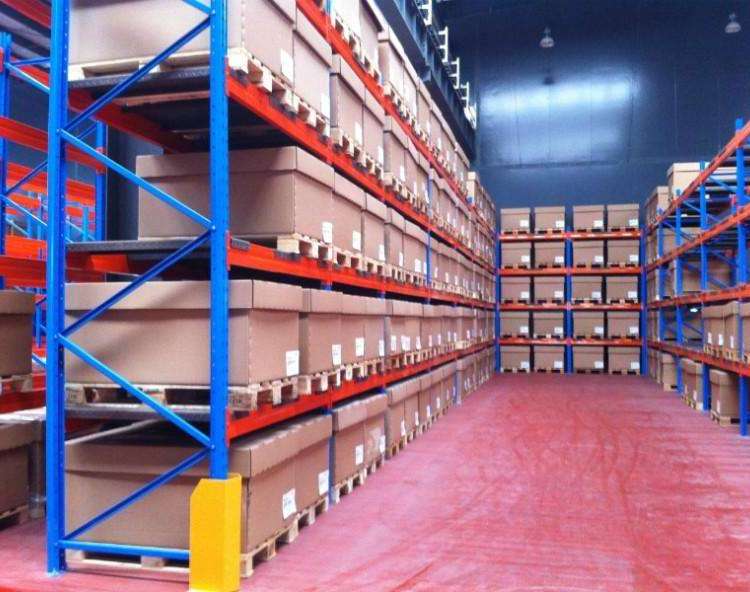
In facilities with ceiling heights exceeding 10 meters, mobile racking can be
integrated with very narrow aisle (VNA) forklifts. This combination requires
precise rail alignment and laser guidance for the truck, but yields exceptional
density.
5. Total Cost of Ownership and ROI Analysis
While the initial capital outlay for mobile racking is
higher than static systems, the return on investment often materializes within
2-4 years through:
Space Savings: Reduced square footage or avoided expansion
costs.
Energy Efficiency: Smaller refrigerated volume in cold
stores cuts electricity bills significantly.
Labor Productivity: Shorter travel distances and
consolidated storage reduce picking times by 15-25%.
Inventory Protection: Controlled access and reduced
handling lower damage rates.
Engineers at Guangshun provide detailed ROI
models based on client-specific throughput and utility costs.
Frequently Asked Questions (FAQ)
Q1: What is the maximum load capacity per mobile racking
carriage?
A1: Carriage capacities vary widely based on design, but
heavy-duty systems can support up to 60,000 kg per carriage (including the
weight of the racking itself). Per pallet level, typical ratings range from 500
kg to 2,500 kg. For ultra-heavy loads (e.g., steel coils), custom engineering is
required.
Q2: How is floor flatness critical for mobile racking
installation?
A2: Extremely critical. Mobile racking requires floor
flatness tolerances of FF/FL 50 or better (per ASTM E1155). Deviations cause
binding, uneven wear on wheels, and can trigger safety sensors. A floor survey
is mandatory before installation, and grinding or self-leveling compounds may be
needed to achieve the required spec.
Q3: Can mobile racking be used in seismic zones?
A3: Yes,
but with additional engineering. Systems must incorporate seismic locks that
automatically engage during an earthquake, preventing carriages from moving.
Base plates and anchors are designed for seismic shear forces, and structural
analysis follows local codes (e.g., IBC, ASCE 7). Mobile racking from
Guangshun can be certified for
Seismic Design Categories up to D or E.
Q4: What maintenance is required for mobile racking
systems?
A4: Routine maintenance includes quarterly inspections of
rails for debris, annual greasing of bearings and drive chains, checking sensor
alignment, and testing emergency stop functions. A professional inspection every
12-24 months is recommended to verify structural integrity and electrical
safety.
Q5: How do I choose between manual, mechanical-assist, and electric
mobile racking?
A5: The choice depends on load weight and frequency
of access. Manual systems (hand-crank) are suitable for light loads and low
access frequency. Mechanical-assist (with gear reduction) reduces effort for
medium loads. Electric systems are essential for heavy loads (e.g., pallet
racking) and high-frequency operations, offering push-button aisle opening and
integration with warehouse management systems.
Q6: Can mobile racking be integrated with automated storage and
retrieval systems (AS/RS)?
A6: Yes, hybrid systems exist where
mobile carriages are combined with automated cranes or shuttles. This is a
specialized engineering application, often used in cold storage to fully
automate putaway and retrieval while maximizing density. Consultation with
experienced integrators is essential.