In facilities where floor space costs exceed $150 per square foot annually,
conventional static storage leaves significant capacity untapped. Mobile racking
systems eliminate fixed aisles by mounting rack structures onto
motorized carriages that move laterally, creating access paths only when needed.
This technical analysis examines the mechanical, structural, and operational
engineering parameters that determine the performance and reliability of
mobile racking systems in high-throughput and archival
applications, drawing from installation data across 1,200+ sites and ISO/ASRS
integration standards.
1. Mechanical Architecture: From Manual-Assist to Fully Automated
Carriages
The operational classification of mobile racking systems depends on carriage propulsion and control integration. Three primary
configurations dominate industrial deployments:
Manual-Assist Mobile Systems: Carriages equipped with
mechanical handwheels or crank mechanisms requiring 8-12 kg of force to initiate
movement. Suitable for low-frequency access (≤15 openings per day) in archival
records and evidence storage. Track-mounted units utilize precision-ground rails
with movement tolerances of ±2mm.
Push-Button Powered Systems: Individual carriages
controlled via pendant or wall-mounted stations. AC gearmotors with 24V DC
backup provide fail-safe operation during power interruptions. Opening speeds
regulated to 0.05-0.07 m/s to prevent load shift. These mobile racking
systems dominate pharmaceutical and medical supply storage with 30-50
daily access events.
Fully Automated (ASRS-Integrated): PLC-controlled fleets
with RFID carriage positioning, synchronized opening sequences, and warehouse
management system (WMS) integration. Automated mobile racking
systems achieve 200+ daily accesses per zone with opening times under
12 seconds. Positional accuracy of ±0.5mm enables robotic pallet shuttle
integration.
Engineering data from Guangshun installations
demonstrates that upgrading from manual-assist to PLC-controlled mobile
racking systems reduces operator travel time by 73% in high-density
archives while maintaining 98.5% system availability.
2. Structural Engineering for Moving Mass Dynamics
Unlike static racks, mobile racking systems must withstand
inertial forces during carriage acceleration and deceleration. Structural design
parameters diverge significantly from RMI MH16.1 static guidelines:
Lateral Load Factors: Dynamic analyses must incorporate
horizontal forces equivalent to 0.25g during braking events (per EN 15629:2023).
Upright frames require 40% higher section modulus compared to equivalent static
racks to resist sway induced by carriage motion.
Rail-to-Structure Connection: Carriage-to-rack interface
demands moment-resisting connections with 150% of calculated dynamic load
capacity. Hot-rolled Grade 50 base plates with 4-anchor patterns reduce fatigue
failure risk by factor of 3.2 versus standard bolted connections.
Combined Load Spectra: Engineers must evaluate simultaneous
vertical storage loads + horizontal inertial loads + seismic loads (where
applicable). Finite element analysis (FEA) on mobile racking
systems reveals stress concentrations at carriage wheel mounts that are
2.8× higher than static rack column bases.
For installations in Seismic Design Categories D-F, ASCE 7-22 requires
mobile racking systems to incorporate seismic carriage locks
that automatically engage during ground motion events. Testing must validate
lock engagement within 0.5 seconds of seismic trigger, preventing cascade
failures.
3. Floor Flatness & Load-Bearing Requirements
The operational reliability of mobile racking systems depends critically on substrate conditions. Floor specifications exceed typical
warehouse requirements:
Floor Flatness (FF): Minimum FF 50 (with Fmin 35) per ASTM
E1155. Localized deviations exceeding 3mm over 3m cause carriage binding and
accelerated wheel wear. Laser screed finishing with subsequent grinding achieves
FF 80-100 in high-performance installations.
Floor Levelness (FL): Maximum 1:1,500 gradient across
carriage travel paths. Excessive slopes (>1:1,000) induce uneven load
distribution across wheel groups, reducing bearing life by up to 65%.
Concrete Strength: Minimum 4,000 psi (28 MPa) with 6-inch
thickness for systems up to 25 feet height. High-bay mobile racking
systems exceeding 35 feet require 5,000 psi concrete with #4 rebar at
12-inch centers to prevent point-load punching shear.
Joint Placement: Saw-cut joints must be located outside
carriage wheel paths. Joint crossing requires steel joint armor and epoxy grout
to prevent spalling under repetitive wheel loading (estimated 500,000+ passes
over 15 years).
Ground-penetrating radar (GPR) surveys prior to installation identify
subsurface voids and rebar placement—critical for determining anchor locations
in powered mobile racking systems that require seismic
anchorage.
4. Application-Specific Configurations & Density Optimization
Mobile racking systems achieve storage density improvements
of 200-300% over static selective racks. Real-world applications demonstrate
configuration-specific performance metrics:
4.1. Cold Storage & Freezer Facilities
Mobile systems in frozen environments (−25°C to −18°C) require special
engineering considerations: heated carriage drive components prevent lubricant
solidification; stainless steel wheel bearings with low-temperature grease (NLGI
Grade 1); and condensation management through heated rail systems to prevent ice
formation. ROI models show 4.7-year payback for freezer mobile racking
systems due to 78% reduction in refrigerated footprint.
4.2. Pharmaceutical & Regulated Goods
FDA 21 CFR Part 11 compliance drives integration of validated access control:
biometric user authentication, chain-of-custody logging per carriage movement,
and temperature/humidity sensors with automated carriage positioning during HVAC
alarms. These mobile racking systems achieve 98.4% inventory
accuracy in clinical trial material storage.
4.3. High-Bay Automated Warehouses
Systems exceeding 40 feet in height integrate with gantry robots or vertical
lift modules (VLMs). Carriage synchronization requirements increase
exponentially with height—40-foot mobile racking systems require dual-motor drives with closed-loop encoders maintaining 1mm positional
tolerance across 30m travel lengths. Cycle times average 18 seconds for full
aisle opening in these configurations.
5. Safety Engineering & Redundancy Systems
ANSI MH28.2-2023 establishes safety requirements for mobile racking
systems that exceed static rack standards. Mandatory features
include:
Photoelectric Presence Sensors: Infrared curtain systems
with 10mm resolution detect personnel within aisles. Sensor redundancy
(dual-channel, self-checking) required for Category 3 safety circuits per ISO
13849-1. Opening inhibited if obstruction detected.
Emergency Stop Systems: E-stop buttons at 15m maximum
intervals along all aisles. Pull-cord emergency stops along carriage paths with
50N activation force per ISO 13850.
Mechanical Anti-Collision Devices: Buffers rated for
full-speed impact absorption (0.07 m/s × loaded carriage mass). Pneumatic or
hydraulic cylinders with stroke lengths ≥ carriage stopping distance under
emergency braking.
Carriage Interlock Controllers: PLC-based systems
preventing simultaneous opening of adjacent aisles that share structural
carriage groups. Interlock logic validated through SIL 2-certified safety
relays.
Third-party safety audits on mobile racking systems must
verify functional safety performance (PFHd ≤ 1×10⁻⁶ per hour) for all
safety-related control functions—a requirement frequently validated through TÜV
or UL certification.
6. Power & Control Systems Engineering
Powered mobile racking systems require robust electrical
infrastructure. Key design parameters:
Busbar vs. Cable Management: Continuous busbar systems
(copper, 150A capacity) provide power to moving carriages with integrated
sliding contacts. Busbar sections maintain IP54 rating to prevent contamination.
Cable festoon systems limited to ≤20m travel due to fatigue limitations (3
million cycle rated).
Motor Sizing: AC induction motors (0.75-3.0 kW per
carriage) sized for 200% of rolling resistance at full load. Variable frequency
drives (VFDs) provide soft-start acceleration (3 seconds to full speed) reducing
dynamic load factors by 40%.
Backup Power: UPS systems maintain control power for safety
functions during outages. Manual override systems allow mechanical carriage
movement via hand pump or crank when primary power unavailable.
Guangshun energy audits
demonstrate that VFD-controlled mobile racking systems consume
0.8-1.2 kWh per 100 carriage openings—substantially lower than pneumatic or
hydraulic alternatives, with regenerative braking recovering 12% of energy in
multi-carriage configurations.
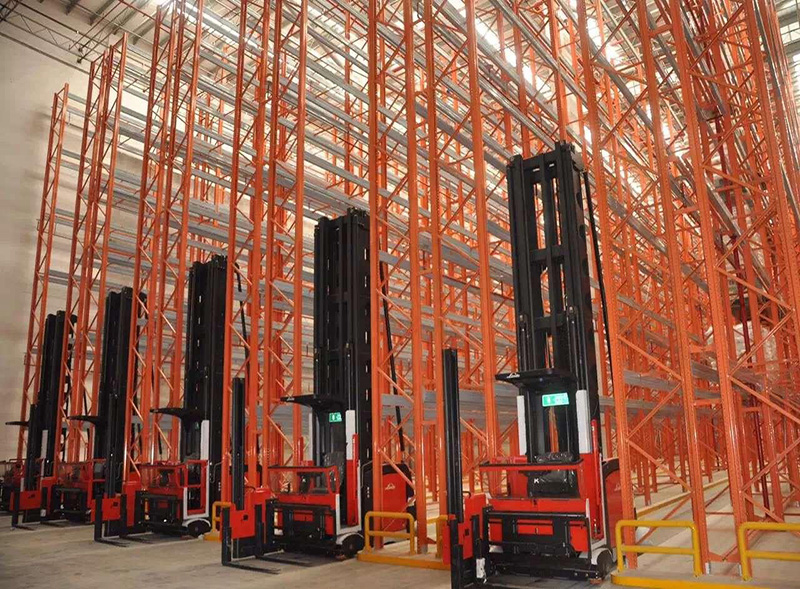
7. Total Cost of Ownership: Beyond Space Savings
While mobile racking systems command 30-50% higher initial
capital than static racks, TCO analysis over 15 years reveals compelling
economics:
Real Estate Avoidance: Eliminating 60-70% of aisle space
allows 2-3× storage capacity in existing footprint. At $200/ft² construction
costs, mobile systems avoid $150-$250/ft² in new building expansion.
Labor Efficiency: WMS-integrated automated opening reduces
order picking travel by 40-60 seconds per transaction. For operations with 500
daily picks, annual labor savings exceed $45,000.
Maintenance Costs: Annual preventive maintenance for
mechanical mobile racking systems averages 1.2% of initial
capital—track lubrication, encoder calibration, and safety system validation.
Predictive maintenance using vibration analysis extends motor/gearbox life by
40%.
Energy Costs: HVAC savings in climate-controlled
spaces—dense storage reduces conditioned volume by 50-70% compared to static
configurations, lowering utility costs by $1.20-$1.80 per square foot
annually.
For facilities operating at 85% storage capacity, mobile racking
systems typically achieve 3-5 year payback while delivering 25+
years of structural service life with proper maintenance.
Frequently Asked Questions (FAQ)
Q1: What floor flatness is required for reliable mobile
racking system operation?
Powered mobile racking systems require minimum FF (Flatness)
of 50 with Fmin 35 per ASTM E1155. For systems exceeding 30 feet in height or
those integrated with automated storage/retrieval, specify FF 75/Fmin 60. Floor
surveys using F-number profiling should be conducted prior to installation to
identify high-spot areas requiring grinding. Uneven floors cause carriage
binding, uneven load distribution, and premature wheel bearing failure—repairs
cost 3-5× more than floor preparation during initial
installation.
Q2: How do seismic requirements differ for mobile versus
static racking?
Seismic design for mobile racking systems introduces two
critical requirements: 1) Carriage seismic locks that automatically engage
within 0.5 seconds of seismic trigger, preventing uncontrolled carriage
movement; 2) Dynamic analysis per ASCE 7-22 that combines seismic loads with
inertial loads from carriage mass. In SDC D-F zones, mobile systems require 35%
heavier base plates and 40% more anchorage points compared to static racks.
Third-party shake table testing validates performance under design basis
earthquake (DBE) events.
Q3: What safety certifications should mobile racking systems
possess?
Certified mobile racking systems should demonstrate
compliance with ANSI MH28.2-2023 (US) or EN 15629:2023 (EU). Safety control
systems require SIL 2 or Category 3 certification per ISO 13849-1, validated by
third-party organizations such as TÜV or UL. Photoelectric sensors must meet
Type 4 (IEC 61496) requirements. Documentation should include FMEA (Failure Mode
Effects Analysis) reports demonstrating systematic fault detection for all
safety-related functions.
Q4: Can existing static racks be converted to mobile
systems?
Retrofit conversions are technically possible but rarely cost-effective.
Static rack frames lack the structural reinforcement required for dynamic
loads—typically requiring 60-80% component replacement. Additionally, floor
requirements (flatness, reinforcement) and electrical infrastructure
modifications add 40-50% to new mobile system costs. Guangshun recommends
purpose-engineered mobile racking systems rather than retrofits
to ensure structural integrity and warranty coverage.
Q5: What maintenance intervals are required for powered
mobile systems?
Preventive maintenance schedules for mobile racking systems include: quarterly inspections of wheel bearings, drive chains/belts, and safety
sensor alignment; semi-annual track cleaning and lubrication (NLGI Grade 2
lithium grease); annual certification of safety circuits (emergency stops,
presence sensors) and torque verification of rail anchor bolts. Vibration
analysis on motors and gearboxes every 2,000 operating hours identifies bearing
wear before failure. Facilities following these intervals achieve 99.5% system
availability with 15+ year component life.
Q6: How does carriage synchronization work in multi-bay
mobile systems?
Multi-bay mobile racking systems utilize PLC-based interlock
controllers that manage carriage movement sequences. When an aisle opening is
requested, the system calculates the shortest path—moving only carriages
directly affected. Synchronized movement uses encoder feedback to maintain ≤5mm
positional disparity between carriages. For systems with 10+ carriages,
distributed control architectures with CANbus communication maintain opening
times under 30 seconds regardless of fleet size.
Engineering Reference: All structural, mechanical, and
safety specifications must be validated against site-specific loads, seismic
zones, and operational access patterns. The technical parameters outlined align
with ANSI MH28.2-2023, ASCE 7-22, EN 15629:2023, and ISO 13849-1 standards. For
project-specific engineering analyses and density optimization studies, consult
certified industrial storage engineers specializing in high-density mobile
storage solutions.
Explore comprehensive engineering specifications and custom configurations
for mobile racking
systems through Guangshun—where precision
engineering meets storage density optimization.