Maximizing Warehouse Density with Narrow Aisle Pallet Racking: 7 Critical Engineering FactorsFor warehouses facing rising real estate costs and the need to expand storage capacity without expanding the building footprint, narrow aisle pallet racking offers a compelling solution. By reducing aisle widths from the conventional 3.5‑4 m down to 1.8‑2.5 m, this configuration can increase storage density by 25‑40% while retaining 100% accessibility to every pallet. However, achieving these gains requires precise engineering of both the rack structure and the material handling equipment that operates within the confined aisles. This article examines the technical parameters, equipment interfaces, and safety considerations essential for successful narrow aisle pallet racking installations, drawing on extensive project data and engineering expertise from Guangshun.
1. Defining Narrow Aisle and Very Narrow Aisle (VNA) Configurations
The terminology around aisle width is often confused. Industry standards distinguish two primary categories:
Narrow Aisle (NA): Aisle widths typically between 2.4 m and 3.0 m. These aisles are serviced by reach trucks or counterbalanced trucks with side‑shifter attachments. The truck must turn into the aisle, requiring a wider intersection at the head of aisles.
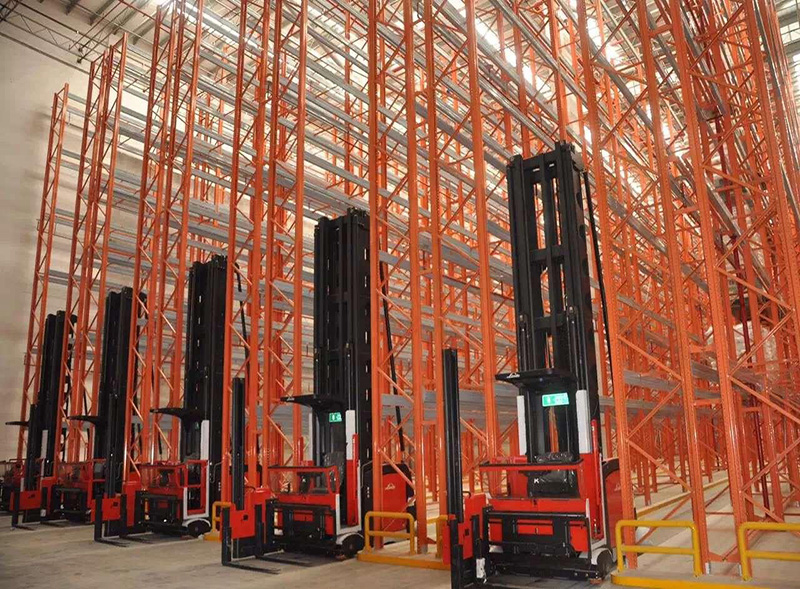
Very Narrow Aisle (VNA): Aisle widths from 1.5 m up to 2.4 m. Operation requires specialised turret trucks or swing‑reach trucks that can rotate forks 180° without turning the truck body. Guidance systems (rail or wire) are mandatory to maintain precise alignment.
Selecting the appropriate width depends on throughput requirements, existing building geometry, and equipment investment. Narrow aisle pallet racking in VNA mode typically yields the highest density but demands higher precision in rack installation and floor flatness.
2. Structural Design Parameters for Narrow Aisle Racking
Racks intended for narrow aisle operation must withstand lateral forces generated by trucks operating in close quarters. Unlike standard selective racks, where horizontal loads are modest, VNA trucks can impart significant side thrust during acceleration, braking, and fork rotation. The following structural factors are critical:
Column stiffness: Upright columns must have adequate moment of inertia to resist deflection under horizontal loads – typically 20‑30% higher than standard rack specifications.
Frame bracing: Diagonal and horizontal bracing must be designed to transfer lateral forces to the floor without excessive sway. Finite element analysis is used to optimise bracing patterns.
Baseplate anchorage: Anchor bolts must be selected for both tension and shear, with pull‑out tests conducted on‑site. Many narrow aisle installations use epoxy‑anchored studs to achieve the necessary holding capacity.
Beam locking: Beam connectors must incorporate positive safety locks that resist dislodgement from side impacts. Guangshun specifies heavy‑duty wedge‑lock connectors tested to withstand 2x the expected lateral loads.
2.1 Tolerances and Plumbness
In narrow aisles, even minor rack misalignment can cause truck collisions or guidance system errors. Industry standards (FEM 9.831, RMI) recommend upright plumbness within 1/500 of height and horizontal alignment of beams within ±3 mm over the aisle length. Achieving these tolerances requires laser‑guided installation and continuous verification during construction.
3. Floor Flatness: The Hidden Foundation
Floor flatness is arguably the most underestimated factor in narrow aisle success. VNA turret trucks rely on stable, level floors to maintain vertical mast alignment and accurate fork positioning. The Concrete Society (UK) and ACI (US) define two key tolerances:
FM2 (Superflat): Required for VNA with wire guidance or rail guidance. Maximum deviation of ±2 mm over a 2 m straightedge, and ±3 mm over a 4 m straightedge.
FM1: Suitable for reach trucks in narrow aisles; tolerances roughly ±3 mm over 2 m and ±5 mm over 4 m.
Floors must also be tested for joint flatness and surface wear resistance. Remedial grinding or topping may be necessary before rack installation. Guangshun provides on‑site floor surveys using digital profiling equipment to verify compliance before committing to equipment procurement.
4. Material Handling Equipment Integration
The synergy between racking and trucks defines narrow aisle productivity. Four types of equipment are commonly used:
Reach trucks (narrow aisle): Operate in 2.5‑3.0 m aisles; cost‑effective but limited lift heights (typically ≤12 m).
Turret trucks (VNA): Available in man‑up (operator rises with forks) or man‑down versions. They require guidance systems and can reach heights up to 18 m.
Wire‑guided systems: A wire embedded in the floor transmits signals to the truck, keeping it centred in the aisle. Installation requires slot cutting and precise calibration.
Rail‑guided systems: Physical guide rails mounted on the floor or on the rack base; simpler to retrofit but may obstruct floor cleaning.
Rack design must accommodate guidance hardware – for example, guide rail brackets bolted to the upright base or clearance for wire loops at aisle ends. The choice of guidance also affects aisle entry/exit speeds and maintenance routines.
4.2 Interface with Rack Structure
In rail‑guided VNA, the guide rails themselves can become part of the lateral restraint system, but they must be isolated from the rack to avoid transmitting truck vibrations into the structure. Guangshun designs guide rail supports with elastomeric isolators to dampen dynamic loads while maintaining alignment.
5. Safety Systems in Narrow Aisle Environments
Operating in confined spaces introduces specific risks. Comprehensive safety packages include:
Aisle entry protection: Physical barriers or light curtains prevent forklifts from entering an aisle where another truck is already present.
Speed limiters: Trucks in narrow aisles are typically governed to 2‑3 m/s to reduce stopping distance and lateral forces.
Overhead clearance sensors: Detect obstructions (e.g., misplaced beams, hanging lights) above the mast.
Seismic restraints: In earthquake zones, additional cross‑aisle bracing and energy‑absorbing baseplates are required. Narrow aisle pallet racking in high‑seismic areas often incorporates special ductile frames tested by shake‑table simulation.
6. Throughput and Productivity Analysis
While narrow aisle systems increase density, they can impact cycle times if not properly planned. Factors influencing throughput:
Travel distance reduction: More pallets stored per square metre means shorter average travel distances – a potential productivity gain.
Lift speeds: Turret trucks typically have slower lift/lower speeds than counterbalanced trucks, but simultaneous lift and traverse can offset this.
Operator skill: VNA operation requires certified training and often longer learning curves.
Comparative studies show that well‑designed VNA systems can achieve 25‑30 picks per hour per truck, comparable to wide‑aisle operations, while storing 35% more pallets. Guangshun has documented cases where conversion to narrow aisle eliminated the need for a warehouse extension, yielding payback periods under 24 months.
7. Common Pain Points and Engineering Solutions
Even with careful planning, certain challenges recur in narrow aisle projects. Below are typical issues and how engineered solutions address them:
Floor settlement: Over time, uneven settlement can misalign racks and guidance. Solution: use adjustable baseplates with shims; monitor settlement with annual surveys.
Wire guidance interference: Metal debris or rebar can disrupt magnetic fields. Solution: pre‑installation ground‑penetrating radar to map rebar; use higher‑frequency guidance systems.
Battery charging logistics: VNA trucks often use heavy batteries; dedicated charging stations with overhead cranes reduce downtime.
Sprinkler clearance: Narrow aisles may obstruct sprinkler spray patterns. Solution: in‑rack sprinklers at each level, designed to NFPA 13 or FM Global standards, with pipe routing integrated into the rack structure.
Frequently Asked Questions (FAQ)
Q1: What is the difference between narrow aisle and very narrow aisle racking?
A1: Narrow aisle typically refers to aisle widths of 2.4‑3.0 m served by reach trucks. Very narrow aisle (VNA) covers widths of 1.5‑2.4 m and requires specialised turret trucks with guidance systems (wire or rail). Both fall under the broader category of narrow aisle pallet racking, but VNA offers higher density at higher equipment cost.
Q2: What type of forklift is used in narrow aisle systems?
A2: Reach trucks are common in narrow aisles (≥2.4 m). For VNA (≤2.4 m), turret trucks or swing‑reach trucks are mandatory. These trucks have forks that rotate left/right without turning the truck, enabling operation in tight spaces.
Q3: What floor flatness is required for VNA?
A3: VNA installations require superflat floors meeting FM2 tolerance: maximum deviation of ±2 mm over a 2 m straightedge and ±3 mm over 4 m. Floors must also be tested for dynamic deflection under truck loads. Guangshun offers floor profiling services to verify compliance.
Q4: Can existing wide‑aisle warehouses be converted to narrow aisle?
A4: Yes, but it requires careful evaluation. Factors include column grid spacing, floor flatness, ceiling height, and building structural integrity. Often, the existing racking must be replaced, and floors may need grinding or overlays. A feasibility study by an experienced integrator like Guangshun is essential.
Q5: How does narrow aisle racking impact fire protection?
A5: Narrow aisles can impede sprinkler coverage, especially in deep‑bay configurations. Fire codes typically mandate in‑rack sprinklers at every tier, with specific spacing and pressure requirements (NFPA 13 or FM Global). Rack design must include vertical channels for sprinkler risers and horizontal water distribution pipes.
Q6: What maintenance is required for wire guidance systems?
A6: Wire guidance requires periodic calibration of the magnetic field strength and inspection of wire continuity. The floor slots should be kept clean of debris. Modern digital systems self‑diagnose and alert operators to faults. Annual system checks by a qualified technician are recommended.
Q7: Is narrow aisle racking suitable for cold storage?
A7: Absolutely. In fact, narrow aisle is common in freezers because it minimises the volume of refrigerated space required per pallet. However, special considerations include low‑temperature steel grades, heated guide rails to prevent ice buildup, and moisture‑proof electrical components. Guangshun has supplied VNA systems for environments down to –30°C with proven reliability.
From floor flatness to truck dynamics, the engineering of narrow aisle pallet racking demands a holistic approach that integrates structural analysis, equipment selection, and operational planning. By partnering with specialists like Guangshun, warehouse operators can achieve the density they need without compromising safety or throughput.