For warehouse operators and logistics engineers, the choice of storage system
directly dictates picking speed, space utilization, and operational safety.
selective
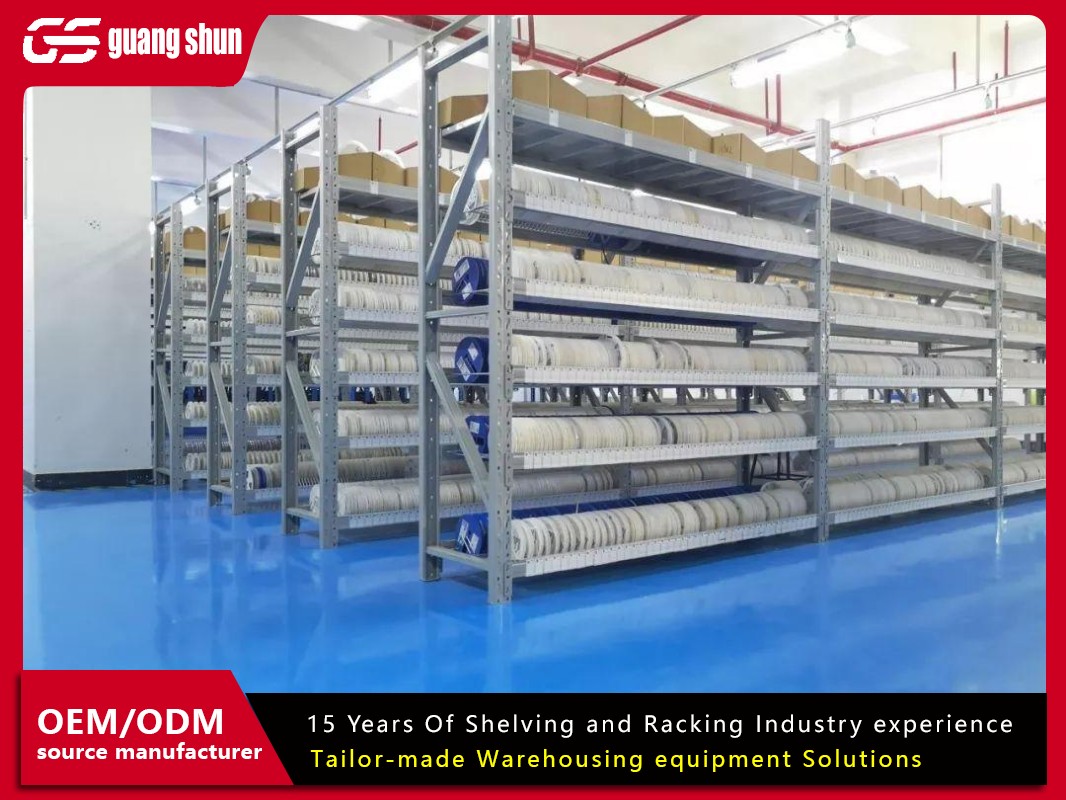
racking — also known as adjustable pallet racking — remains the
most widely deployed pallet storage solution globally, representing over 75% of
industrial racking installations. This guide provides a data-driven examination
of technical parameters, application-specific performance metrics, and lifecycle
cost analysis, drawing on industry standards and engineering best practices.
Unlike dense storage alternatives that compromise on accessibility,
selective
racking offers 100% direct access to every pallet position, making
it the preferred architecture for SKU‑intensive environments, FIFO (first-in,
first-out) inventory regimes, and facilities with high daily throughput. The
following sections detail structural design principles, comparative performance
benchmarks, and actionable optimization strategies.
1. Core Engineering Parameters of Selective Racking
Understanding the mechanical and dimensional standards of selective
racking is essential for specification and safety compliance.
Modern systems are built around hot-rolled steel upright frames and step-beam
horizontal members, with standardized load tables per EN 15512 or RMI
specifications.
1.1 Frame & Beam Specifications
Upright columns: Typically 80–120 mm deep with C-channel or
perforated box sections. Steel grade S280–S350 with yield strength ≥ 280 MPa.
Hole punching patterns (e.g., 75 mm vertical pitch) allow beam height adjustment
in 2" or 75 mm increments.
Beam capacity: Standard step beams support 1,500–4,500 kg
per pair at spans up to 3,700 mm. Heavy-duty box beams extend capacity to 5,500
kg per level.
Frame bracing: Horizontal and diagonal braces (e.g.,
40×40×2.5 mm) resist longitudinal and lateral forces. Seismic zone D/E require
additional brace sets or base plates with anchor bolts of M20 grade.
1.2 Dimensional Tolerances & Load Deflection
Industry practice limits beam deflection under full load to L/180 (span/180).
For a 2,700 mm beam span, maximum allowable deflection is 15 mm. This ensures
stable pallet support and safe forklift operations. Upright frames must
withstand 0.5g horizontal seismic forces without permanent deformation when
anchored correctly.
2. Application Scenarios & Operational Pain Points Solved by Selective
Racking
selective
racking is not a one-size-fits-all solution, but its adaptability
addresses three chronic warehouse challenges: low inventory turnover, SKU
proliferation, and retrieval bottlenecks.
2.1 High-Mix, Low-to-Medium Volume Operations
Third-party logistics (3PL) providers and e-commerce fulfillment centers
manage thousands of SKUs with variable demand. Selective racking enables each
pallet location to be assigned to a distinct SKU, removing the need to relocate
stored goods. A 2023 industry survey of 150 warehouses found that switching from
drive-in to selective racking reduced average pallet retrieval time by 42% while
increasing inventory accuracy to 99.5%.
2.2 FIFO Compliance for Perishable & Regulated Goods
Pharmaceutical, food, and chemical sectors mandate strict lot rotation.
Selective racking's direct-access design naturally supports FIFO without complex
rewarehousing. For cold storage applications (−25°C to +5°C), selective
racking fabricated with low-temperature steel (e.g., S275NL) and
anti-condensation coatings prevents brittle failure and corrosion.
2.3 Mitigating "Out-of-Stock" & Rework Costs
Dense storage systems often require reshuffling pallets to reach deep
positions, causing labor rework and product damage. With selective racking, each
pallet is one forklift movement away. A typical grocery distribution center with
8,000 pallet positions reported a 27% drop in labor hours for put-away and
picking after converting from double-deep to selective racking, despite a 18%
reduction in theoretical storage density — a trade-off justified by throughput
gains.
3. Comparative Analysis: Selective Racking vs. High-Density
Alternatives
While selective racking maximizes accessibility, it yields
lower area density than drive-in, push-back, or pallet flow systems. The table
below quantifies key trade-offs based on standard 1,200×1,000 mm Euro
pallets.
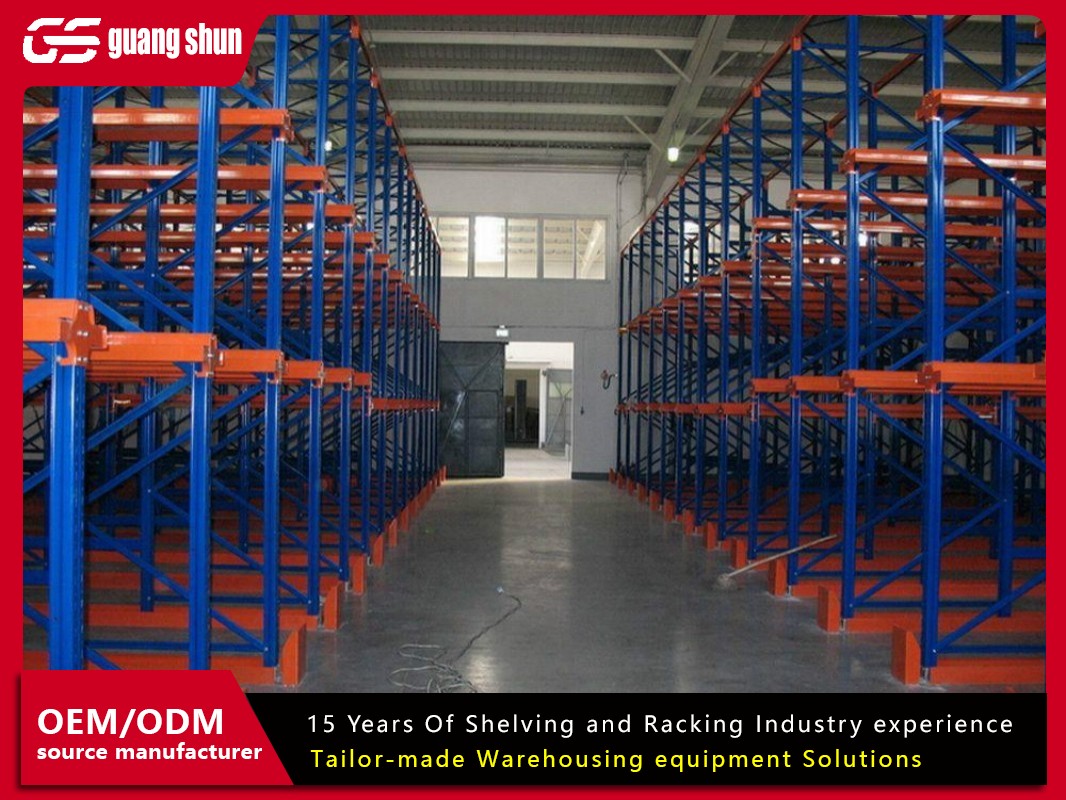
Drive-in racking: Storage density +60% vs. selective
racking. Drawbacks: LIFO only, 30% slower retrieval, higher damage risk.
Push-back racking: Density +40% vs. selective, but only 3-6
pallet positions per lane, limited SKU count per lane.
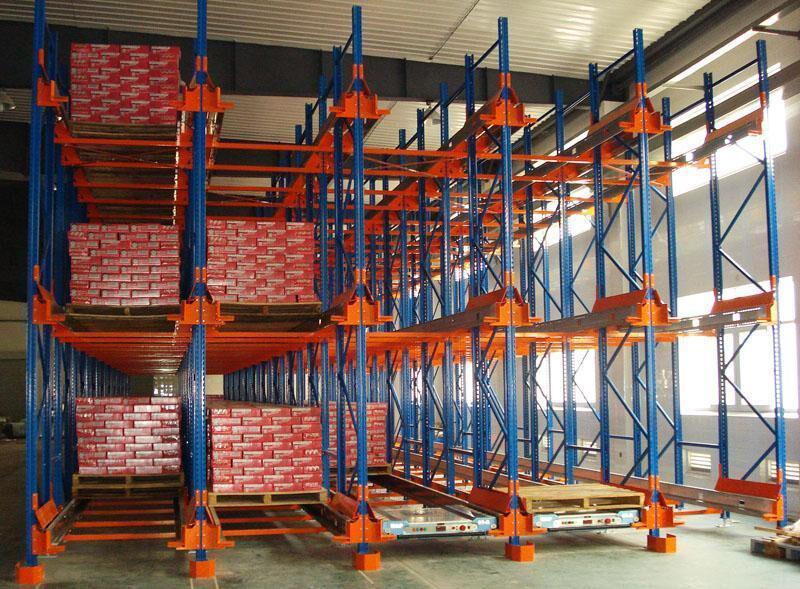
Pallet flow (gravity): Density +35% vs. selective, FIFO
automatic, but 50% higher capital cost and complex maintenance.
Double-deep racking: Density +30% vs. selective, requires
reach trucks with 2.5–3 m depth reach; access to rear pallet requires moving
front pallet.
Decision matrix: Choose selective racking when SKU count > 500, daily
pallet movements > 800, or when inventory turns exceed 6 times per year. For
frozen goods with 200 SKUs and low turns, drive-in may be more economical.
4. Optimizing Aisle Width & Forklift Interface
Aisle width directly influences storage density and equipment cost. Standard
counterbalance forklifts require aisles of 3.5–4.0 m (based on a 2.7 m turning
radius). Narrow-aisle reach trucks reduce this to 2.7–3.0 m, increasing slot
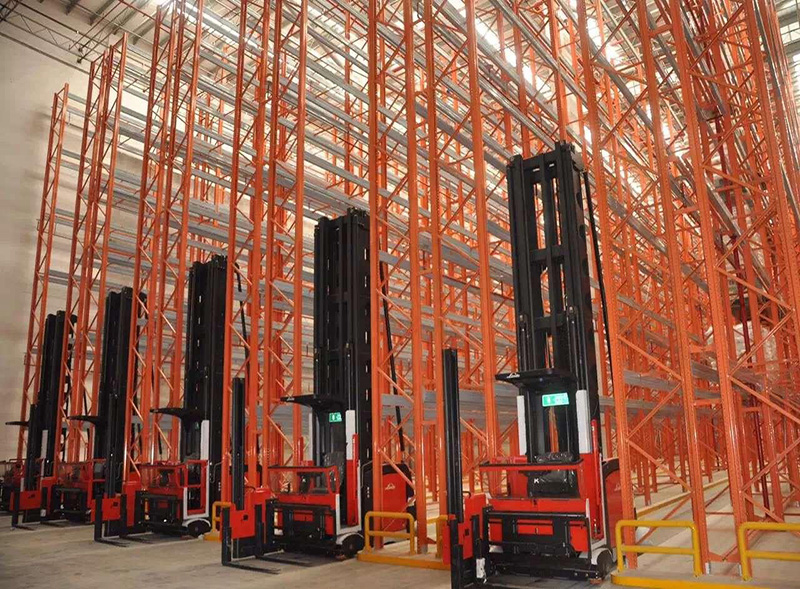
count by up to 28% on the same floor area. For very narrow aisle (VNA)
configurations (1.8–2.0 m), specialized guided trucks can be used, but they
require wire guidance and raise costs by 35–50%.
As a rule, reducing aisle width from 3.6 m to 2.8 m reclaims 15% of the
warehouse footprint for additional selective racking beams.
However, aisle width reductions require evaluation of truck duty cycles, battery
change intervals, and operator training.
5. Safety, Load Notices & Regulatory Compliance
Compliance with EN 15512 (Europe) or RMI ANSI MH16.1-2021 (North America) is
non-negotiable. Key safety provisions include:
Column guards: Required for all aisles with forklift
traffic. Energy absorption of at least 7,000 J is recommended.
Load indicators: Each beam level must display maximum
uniform distributed load (UDL) and point load ratings.
Seismic anchoring: In regions of moderate to high
seismicity (peak ground acceleration > 0.2g), sway bracing and base plates
with oversized anchor bolts (M20 grade 8.8) are mandatory.
Regular inspections: At intervals not exceeding 12 months
per EN 15635. Inspect for bent uprights (out-of-plumb > 1:200), cracked
welds, and damaged beam locking tabs.
Selective
racking systems from experienced engineers incorporate these
features from the design stage, preventing costly retrofits.
6. Engineered Solutions by Guangshun for Maximum ROI
With 18+ years in the material handling industry, Guangshun delivers custom
selective racking configurations that integrate seismic
calculations, finite element analysis (FEA), and turnkey installation. Their
engineering team evaluates floor flatness (FB tolerance per DIN 18202), anchor
pull-out resistance, and dynamic impact loads. Guangshun also provides seismic
upgrade packages for existing racks, incorporating base plate stiffeners and
additional diagonal bracing, validated by third-party structural reviews.
For a recent 12,000-pallet-position project in a Dutch automotive logistics
hub, Guangshun designed a 12‑meter
high selective racking array with beam levels adjustable at 50 mm increments.
The solution achieved a 99.2% direct access rate while maintaining a 3.2 m aisle
width for reach trucks, resulting in a calculated ROI of 14 months based on
labor savings alone.
7. Total Cost of Ownership & Depreciation Analysis
Beyond initial procurement, long-term cost factors include:
Maintenance: Annual inspection and repair budget: 1.5–2% of
initial rack investment. Selective racking has lower maintenance than
moving-rack systems (no rails, chains, or carts).
Repairability: Damaged uprights or beams can be
individually replaced without dismantling adjacent bays. Typical replacement
part lead time: 2–3 weeks.
Reconfiguration costs: As SKU profiles change, selective
racking beam levels can be relocated. Labor cost for reconfiguring 50 bays:
approx. 8–10 man-hours.
Depreciation: According to standard accounting practices
(20–25 years useful life), selective racking systems often remain serviceable
for three decades with proper maintenance, far exceeding automated storage
(ASRS) which requires electronics overhaul every 7–10 years.
8. Why Selective Racking Remains the Industry Benchmark
For warehouse managers who prioritize inventory accessibility, picking
accuracy, and operational flexibility over absolute storage density, selective
racking delivers the most balanced performance profile. Its
technical maturity — standardized components, predictable load deflection, and
widespread compatibility with material handling equipment — results in lower
total cost of ownership compared to niche systems. When engineered correctly
with certified suppliers like Guangshun, selective racking also
adapts to future automation (e.g., automated guided vehicles, picking robots) by
providing clear alignment paths and consistent pallet interfaces.
Evaluate your warehouse throughput versus storage requirement using the 80/20
rule: if 80% of your picks come from 20% of SKUs, selective racking will serve
those fast-movers with minimal travel distance, while slower SKUs can be placed
in higher positions without harming efficiency. No other pallet racking system
offers the same combination of simplicity, safety, and adaptability.
Frequently Asked Questions (FAQ)
Q1: What is the typical lead time for a custom selective
racking installation?
A1: For standard configurations (3–5 beam levels, standard
depth frames), engineering and fabrication take 4–6 weeks from approval of shop
drawings. Large projects (over 5,000 pallet positions) may extend to 10–12 weeks
due to seismic bracing or special coatings. Installation on site typically
requires 1–2 weeks per 1,000 pallet positions, depending on floor flatness and
anchor drilling conditions.
Q2: Can existing selective racking be reconfigured to
different pallet sizes?
A2: Yes. Beam levels can be moved to any upright hole
position (usually 75 mm pitch). However, if pallet depth changes (e.g., from 800
mm to 1,000 mm), you may need new beam sets with longer spans. Frame depth
(e.g., 800 mm vs 1,100 mm) is fixed; changing depth requires upright
replacement. Always revalidate load capacity after reconfiguration — moving
beams to higher positions increases the load on lower frames. A structural
analysis is recommended for any change exceeding 20% of original design
load.
Q3: What maximum load can a single selective racking beam
level support?
A3: Beam capacity depends on span length, beam profile, and
steel grade. For standard step beams with 2,700 mm span, the safe working load
(SWL) per beam pair ranges from 1,800 kg to 3,200 kg. Heavy-duty box beams
(140×80 mm) on 2,500 mm span can support up to 5,500 kg per level. Always
consult the manufacturer's load table — never exceed SWL, as deflection beyond
L/180 can cause beam lock failure and cascading collapses. For loads above 6,000
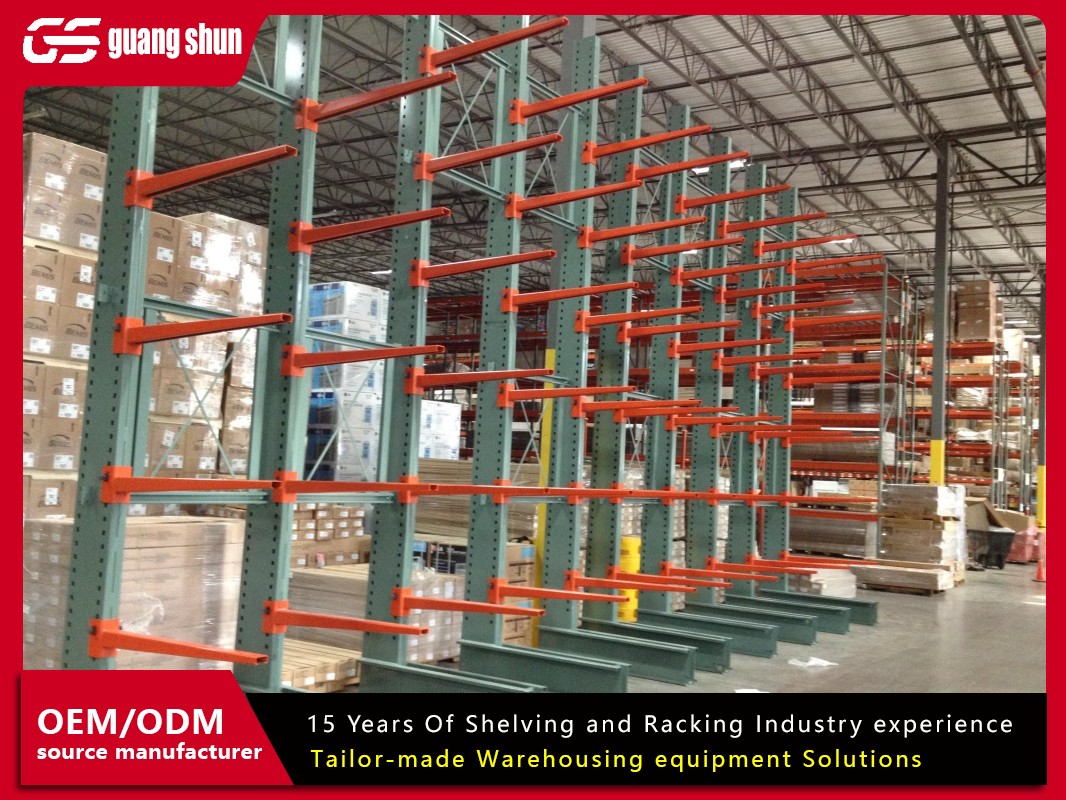
kg per level, consider cantilever or structural steel
shelving.
Q4: How does selective racking compare to double-deep
racking in terms of productivity?
A4: Double-deep racking stores two pallets deep per lane,
increasing density by ~30% but requiring a reach truck with 1,200–1,500 mm fork
stroke. For each rear pallet retrieval, the front pallet must be moved
temporarily, adding 30–45 seconds per operation. In a warehouse with 600
double-deep picks per shift, this adds 6–7 labor hours daily. Selective racking
avoids this double handling. However, double-deep can be cost-effective for
slow-moving items (turns < 3 per year). Productivity breakeven analysis shows
selective racking outperforms double-deep when throughput exceeds 12 pallet
moves per hour per aisle.
Q5: Are special versions of selective racking required for
cold storage (−25°C)?
A5: Yes. At sub-zero temperatures, standard carbon steel
(S235JR) becomes susceptible to brittle fracture. Cold-storage selective racking
must use steel with guaranteed impact toughness at −20°C or −30°C, such as S275N
or S355NL grade (normalized). Additionally, all welds require preheating (min
100°C) and post-weld heat treatment to relieve residual stresses. Galvanization
or epoxy coatings with low-temperature flexibility (no cracking down to −30°C)
are essential. Suppliers like Guangshun offer certified
sub-zero racks tested per EN 1993-1-10.
Q6: What seismic performance requirements apply to selective
racking in high-risk zones?
A6: According to ASCE 7-22 and EN 1998-1 (Eurocode 8),
selective racking in seismic design category D or higher must consider both
static equivalent lateral force and nonlinear dynamic analysis. Requirements
include: oversized slotted base plates with four anchors per upright (not two),
horizontal diagonal braces at each level in both longitudinal and transverse
directions, and beam-to-upright connections with positive locking against
vertical uplift. Sway frames (portal bracing) every 3–4 bays prevent progressive
collapse. Always request seismic calculation reports with a professional
engineer stamp for projects in zones with PGA >
0.2g.
©
2026 Guangshun Storage Equipment. Technical specifications based on EN 15512 and
RMI MH16.1. For site-specific engineering assistance, contact Guangshun's engineering
department.