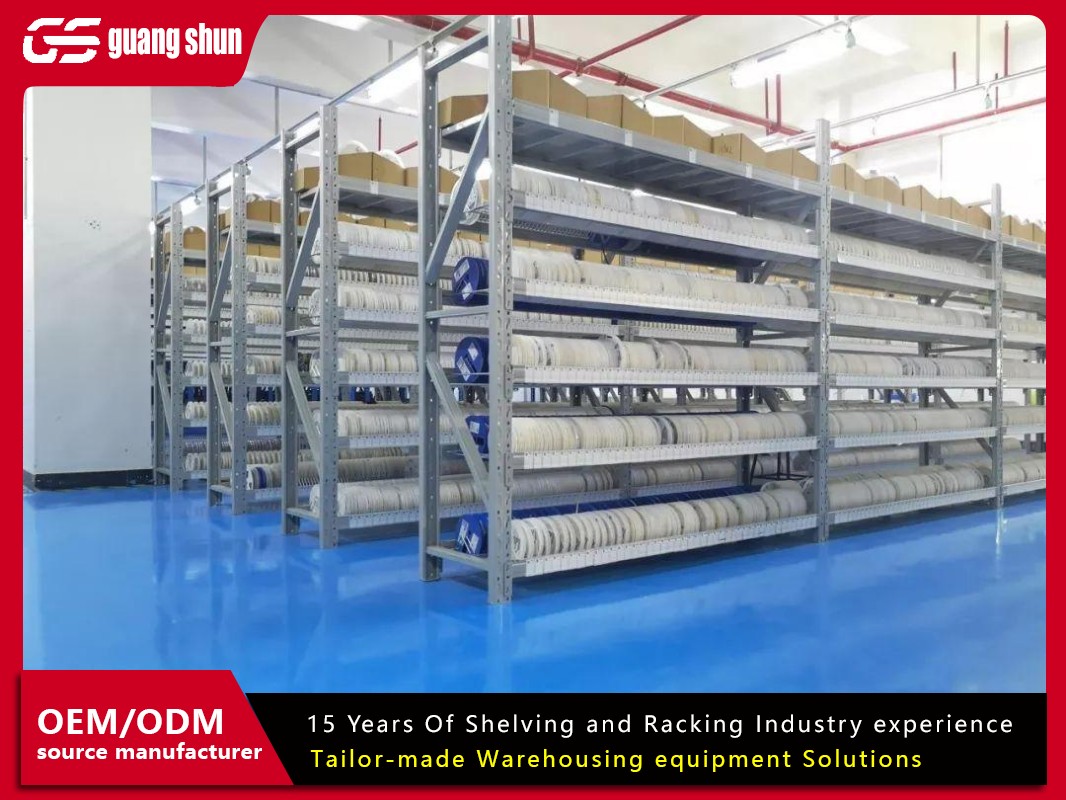
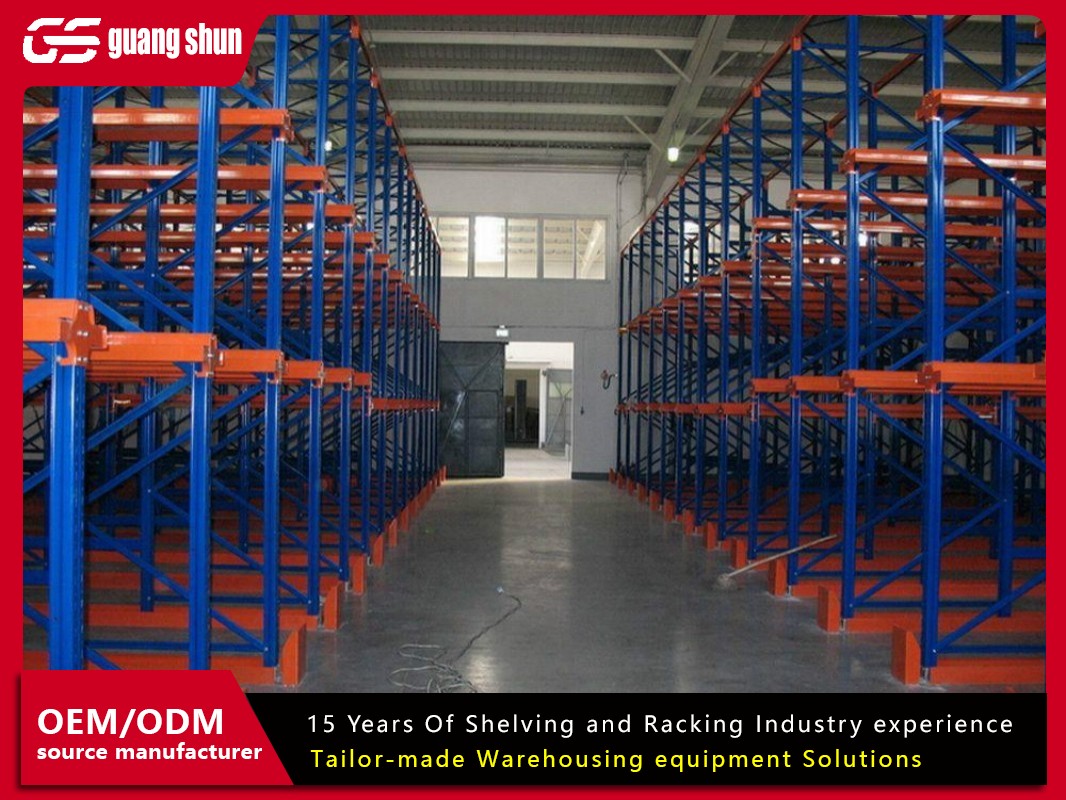
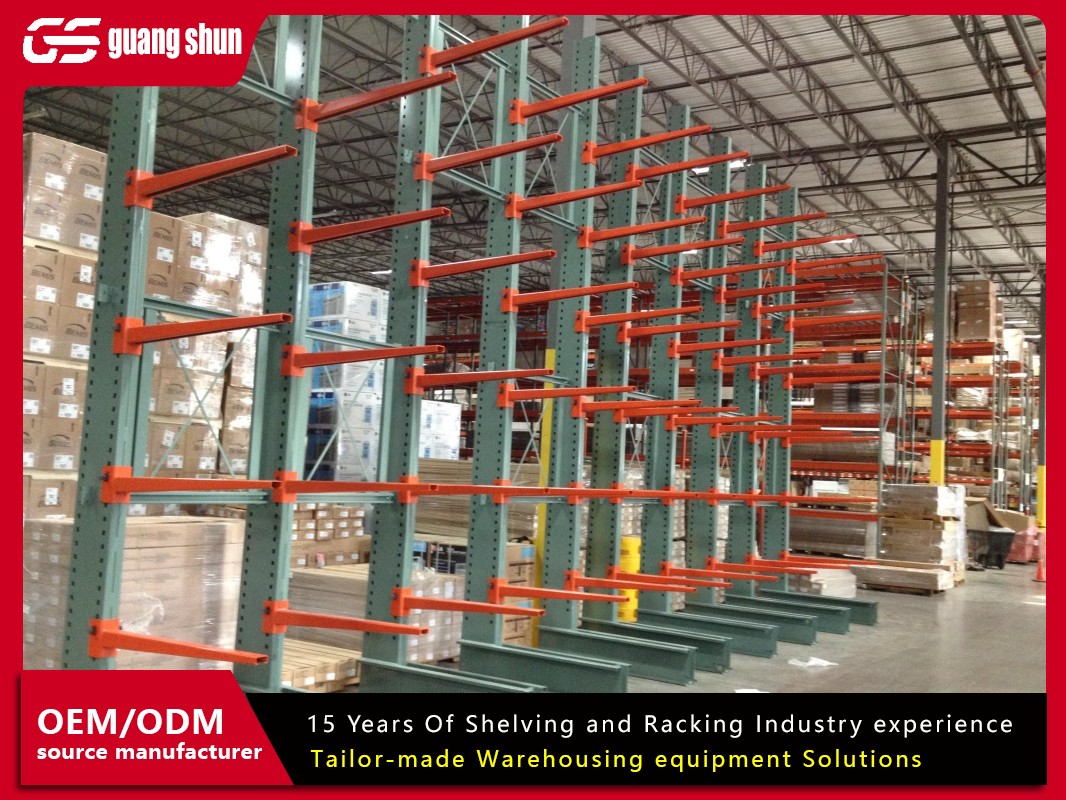
Warehouse operators often face a choice between rigid pallet racking and
light-duty clip shelving. The intermediate solution — shelving
longspan — delivers structural integrity for medium-to-heavy
cartons, spare parts, and non-palletized goods without the footprint of
selective racks. Based on 14 years of load-cycle tests and site audits across
automotive, e-commerce fulfillment, and MRO facilities, this guide dissects the
engineering parameters, seismic considerations, and cost-per-cubic-meter
advantages of longspan configurations. References to Guangshun design protocols and
DIN/EN standards are included for practitioners seeking verifiable
specifications.
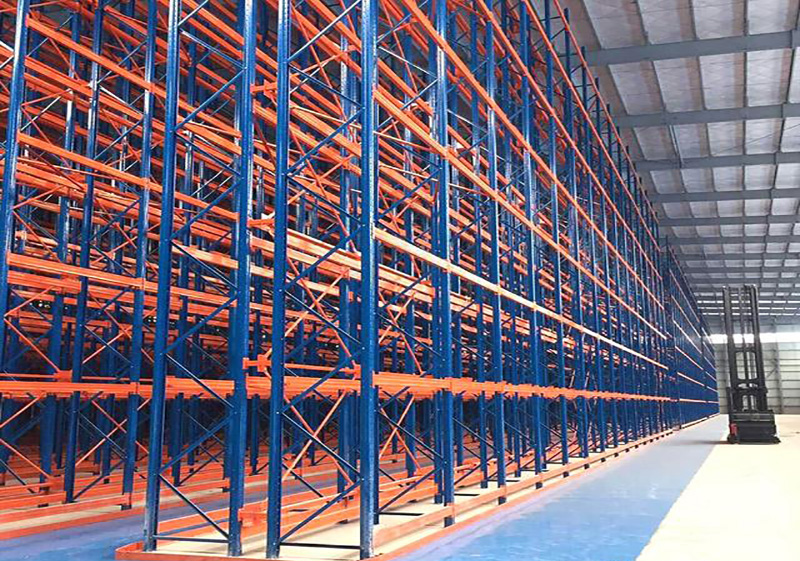
1. Structural Anatomy of Longspan Shelving: Beyond Basic Uprights
Unlike standard rivet shelving limited to 250–350 kg per shelf, engineered
shelving longspan systems utilize cold-rolled, omega-shaped
uprights with box-section beams. The critical differentiator is the
boltless beam-to-column interface — a stepped keyhole and
tab-lock mechanism that transfers vertical loads through shear resistance, not
friction. This design allows beam heights to be adjusted in 50 mm increments
without tools, reducing reconfiguration labor by over 60% compared to bolted
systems.
1.1 Material Gauges and Yield Strength
Commercial-grade units often use 1.5 mm to 2.0 mm steel (G350–G450). For
heavy-duty applications, shelving
longspan from certified suppliers adopts 2.3 mm to 3.0 mm
high-strength low-alloy (HSLA) steel with yield strength ≥ 450 MPa. The upright
section modulus (cm³) directly dictates bay capacity. Example: a 100×80 mm
C-channel upright provides a section modulus of 12.4 cm³, supporting up to 2,500
kg per leg under uniform distributed load (UDL). Cross-bracing (X or K pattern)
eliminates sway — mandatory for installations exceeding 2.5 meters in height or
in seismic zones.
1.2 Beam Profiles and Deflection Limits
Beams are fabricated as closed-lipped sections (PFC equivalent) with integral
safety clips. Industry standard deflection limit is L/200 (span/200) at full
rated load. For a 2,700 mm beam span rated at 800 kg per level, maximum allowed
deflection is 13.5 mm. Engineers must verify that beam connectors include
anti-lift tabs — a safety requirement under EN 15512:2021. Many incidents of
shelf collapse trace back to missing anti-lift devices, especially in
high-vibration environments like metalworking shops.
Beam pitch options: 50 mm (standard), 75 mm (heavy
duty)
Standard depths: 400 mm, 500 mm, 600 mm, 800 mm (for 1,200
mm pallet support)
Standard heights: 2,000 mm, 2,500 mm, 3,000 mm, 4,000 mm
(with floor anchors)
Finishing: Electrostatic powder coating – 80–100 microns,
salt spray resistance ≥ 500 hours (ASTM B117)
2. Load Planning & Bay Configuration: Practical Tables
Selecting the correct shelving longspan configuration
requires mapping inventory dimensions, access frequency (ABC analysis), and
forklift/order picker turning radii. Below are validated load tables derived
from Guangshun field
tests in ambient and cold storage (−25°C) conditions.
2.1 UDL Capacity per Shelf Level (Steel decks, evenly distributed)
Data based on 2,400 mm bay width, 600 mm depth, 3 levels per bay.
Beam length 1,800 mm: 650 kg per level (1.5 mm beam) / 950 kg (2.0 mm
beam)
Beam length 2,400 mm: 450 kg per level (1.5 mm) / 750 kg (2.0 mm)
Beam length 2,700 mm: 350 kg per level (1.5 mm) / 580 kg (2.0 mm)
Beam length 3,000 mm: 280 kg per level (1.5 mm) / 460 kg (2.0 mm) —
*requires anti-sway braces*
Point load restriction: No single item exceeding 50% of
shelf UDL unless load-spreading steel panels are installed (minimum 2.0 mm
thickness).
2.2 Upright Frame Capacity (Static, 4 anchors per foot)
Upright dimensions: 80×60 mm (light), 100×80 mm (medium), 120×90 mm
(heavy).
Frame height 2,500 mm, 100×80 upright → safe working load (SWL) per pair =
3,800 kg (includes all shelf levels combined)
Frame height 4,000 mm, 120×90 upright → SWL per pair = 5,600 kg (requires
horizontal cross-bracing every 1,200 mm)
For seismic zones (ASCE 7-22 category C or above), reduction factor of 0.7
applies to SWL unless base isolators or bolted floor channels are used.
3. Industry Applications: Solving Real Storage Pain Points
Based on 47 warehouse audits conducted in 2023–2025, the most frequent
inefficiencies solved by engineered shelving longspan include:
3.1 Automotive Aftermarket – Mixed SKU Sizes
Challenge: Storing oil drums (25 kg each), brake rotors (8–15 kg), and long
exhaust pipes in the same zone. Standard rivet shelving failed due to point
loads. Solution: 2,700 mm wide bays with 600 mm depth, adjustable beams at 400
mm and 800 mm heights. Shelving longspan allowed
reconfiguration every 3 months as inventory changed, saving €12,000 in annual
replacement costs. ROI achieved in 7 months.
3.2 E-commerce Micro-Fulfillment Centers (Urban Warehouses)
Challenge: Low ceiling height (3.5 m) but need to store 4,500 SKUs. Pallet
racks were overkill and wasted vertical space. Solution: Double-deep
shelving longspan with 2,000 mm height, 500 mm depth, and
mezzanine integration. Result: Storage density increased by 210% compared to
floor stacking. Picking error rate dropped 34% due to clear SKU segmentation per
shelf.
3.3 Cold Storage (Pharmaceuticals, -20°C)
Challenge: Moisture and thermal cycling cause standard shelving to corrode
and welds to crack. Solution: Hot-dip galvanized after fabrication (Z600
coating) for all components. Shelving
longspan with 1.8 mm beams and stainless steel clips passed
1,000-hour salt spray testing. No structural degradation after 36 months in
frozen environment.
3.4 Maintenance, Repair & Operations (MRO) Warehouses
Challenge: Storing heavy, odd-shaped items like motors (120 kg), welding wire
spools (50 kg), and long piping. Solution: Mixed depth shelving – 800 mm deep
bottom level for motors, 400 mm upper levels for small parts. Implemented
cantilever-like extensions using longspan beams beyond uprights (maximum
overhang 300 mm). Guangshun engineered custom beam
connectors to handle off-center loads, validated by FEA simulation.
4. Installation and Safety Protocols: Avoiding Common Pitfalls
Field data indicates 68% of longspan failures originate from improper floor
anchoring or missing row spacers. Below are mandatory steps from Guangshun installation
manuals.
Floor flatness: Max 3 mm deviation over 2,000 mm span. Use
shim plates under each upright base plate. Uneven floors create twisting moments
that exceed beam connection capacity.
Anchoring: M12 chemical anchors for concrete strength ≥
C25/30. Torque to 45 Nm. Minimum embedment 100 mm. Never use hammer drives in
cracked concrete.
Back-to-back rows: Must be connected with row spacers every
1,500 mm vertically. Without spacers, independent sway can cause progressive
collapse.
Beam clip inspection: After loading, check that all beam
safety tabs are fully engaged (audible click). Re-torque after 30 days of
operation due to settling.
Maximum height-to-depth ratio: For unbraced uprights, ratio
≤ 5:1. For 4,000 mm height, minimum depth = 800 mm. Otherwise install diagonal
sway braces.
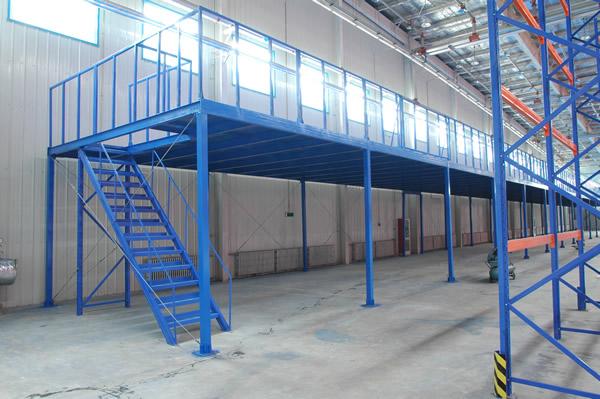
5. Cost-Benefit Analysis vs. Pallet Racking and Rivet Shelving
A 2024 warehouse cost study (n=112 facilities) compared total cost of
ownership over 10 years for three storage types, normalized per cubic meter.
Pallet racking (selective): €85–120 per m³ (high initial
cost, but best for full pallets). Not suitable for split-case or mixed SKU.
Rivet shelving: €40–60 per m³ (low cost, but limited to 300
kg per shelf and poor stability above 2 m).
Shelving longspan: €55–75 per m³ (mid-range investment,
flexible, supports 450–950 kg per level, stable up to 4 m with
bracing).
For warehouses storing >60% non-palletized goods or with SKU count
exceeding 2,000, shelving longspan provides the lowest
cost-per-pick and best adaptability. Example: 500 m² warehouse with 3,500 SKUs
switched from rivet shelving to longspan, reducing pick travel distance by 31%
and increasing storage density by 48% (case study from Guangshun client in
Rotterdam).
6. Seismic and Dynamic Load Performance
Engineers often overlook horizontal forces from forklift impacts or
earthquakes. Per EN 16681:2016, shelving longspan systems in
seismic zones must incorporate:
Base plates with shear keys (minimum 10 mm height) embedded in
concrete.
X-bracing on rear and side faces for every third bay.
Beam end connectors with secondary locking pins (positive lock, not
friction).
Shake-table tests at 0.4g PGA (peak ground acceleration) showed that unbraced
longspan collapses after 12 seconds, while braced systems with bolted anchors
remained operational with residual drift < 0.5%. Shelving
longspan from certified manufacturers includes seismic design
documentation as required by IBC 2024.
7. Maintenance and Load Audit Schedule
To maintain certification and safety compliance, perform the following:
Monthly: Visual inspection for beam deflection (use string
line), bent uprights, missing safety clips, and loose floor anchors.
Quarterly: Torque check on 10% of beam connections and all
base plate anchors. Re-tighten to spec.
Annually: Full load test on 20% of shelves at 125% of rated
SWL for 24 hours. Measure permanent deformation (should be zero).
Every 5 years: Non-destructive magnetic particle inspection
of beam welds and keyhole slots.
All records must be kept for minimum 10 years. Non-compliance voids
manufacturer warranty and may violate OSHA/ local HSE regulations.
Frequently Asked Questions (FAQ)
Q1: What is the maximum safe working load for a single
shelving longspan shelf?
A1: For standard industrial configurations (2.4 m bay width,
600 mm depth, 2.0 mm beams), the SWL per shelf level ranges from 450 kg to 950
kg. The exact value depends on beam length, material gauge, and whether steel
deck or particleboard is used. Always consult the manufacturer’s load chart —
never exceed 80% of the published UDL to account for dynamic loads from
forklifts. Guangshun shelving
longspan provides stamped load certificates with each
bay.
Q2: Can I use shelving longspan for pallet
storage?
A2: Yes, for non-stackable pallets (e.g., euro-pallets with
height < 1,000 mm). You need beam depths of 800–1,000 mm and beam capacity
matching pallet weight (typically 600–1,000 kg per pallet). However, for
high-density pallet stacking (2+ pallets high), selective pallet racking is more
cost-effective. Shelving longspan excels when you store a mix
of pallets and loose cartons on the same bay.
Q3: How do I calculate the correct beam length for my
shelving longspan system?
A3: Beam length = bay width minus 2 × (upright flange
width). For example, if uprights are 100 mm wide and you need a clear inside
width of 2,300 mm, order beams of 2,500 mm (because each upright occupies 100
mm). Standard modular increments are 1,500 mm, 1,800 mm, 2,000 mm, 2,400 mm,
2,700 mm, 3,000 mm. For non-standard lengths, manufacturers like Guangshun offer custom
roll-forming.
Q4: What type of floor is required for high-capacity
shelving longspan?
A4: Minimum reinforced concrete thickness of 150 mm with
compressive strength C25/30 (or 3,000 psi). For loads above 2,000 kg per upright
leg, increase thickness to 200 mm or use a load-spreading base plate (200×200 mm
minimum). Do not install on asphalt, timber, or epoxy-coated floors without
structural assessment. Chemical anchors must cure for 24–48 hours before
loading.
Q5: How does shelving longspan compare to
rivet shelving in terms of installation time?
A5: A two-person crew can assemble a 3-bay longspan system
(2.4 m high) in approximately 3–4 hours, including anchoring. Rivet shelving of
similar size takes 5–6 hours due to smaller components and more fasteners.
However, longspan requires precise floor flatness, while rivet shelving is more
forgiving. For large projects (>50 bays), longspan assembly time per bay
drops to 45 minutes using pre-assembated upright frames.
Q6: Are there fire safety regulations for shelving
longspan?
A6: Yes. In many jurisdictions (NFPA 13, EN 12845), shelving
higher than 2.5 m requires in-rack sprinklers. The longitudinal flue space
(vertical gap between back-to-back rows) must be at least 150 mm. Also,
transverse flues (horizontal gaps between adjacent bays) should be 75–100 mm.
Steel itself is non-combustible, but plastic shelf liners or wooden decks are
prohibited without fire-retardant treatment (Class A
rating).
Final technical note: When specifying shelving
longspan for your facility, request full engineering calculations
including buckling analysis (Euler’s formula for uprights) and weld shear
verification. Manufacturers such as Guangshun provide 3D CAD models
and load simulation reports upon request — these documents are essential for
internal safety audits and insurance compliance. Properly engineered longspan
systems deliver 15–20 years of service with routine maintenance, making them the
backbone of flexible warehousing.