Storing long, unwieldy materials in a warehouse is a persistent problem.
Pipes, timber, metal profiles, PVC conduits, and extruded aluminum do not fit
neatly onto standard pallet racking. They protrude into aisles, create tripping
hazards, and waste vertical cube space. Over the past decade, swing arm
shelves have become a standard engineering answer to this problem
across manufacturing, construction supply, and third-party logistics operations.
This article breaks down the mechanical logic, load calculations, and deployment
considerations that determine whether a swing arm installation succeeds or
becomes a maintenance liability.
What Defines a Swing Arm Shelf System
A swing arm shelf is a storage structure built around horizontal cantilevered
arms that pivot outward from a central vertical column or frame. Unlike fixed
cantilever racking, each arm rotates horizontally, typically between 90 and 180
degrees. This movement allows an operator to swing one or more arms aside to
access materials stored behind them, eliminating the need to remove
front-stacked items first.
The core components of a typical unit include:
Vertical column: A structural steel upright, usually
fabricated from H-beams or square tubing, anchored to the floor with base
plates.
Pivot assembly: A reinforced hinge mechanism with bushings
or bearings that allows each arm to rotate under load.
Load-bearing arm: A horizontal member, often C-channel or
rectangular tube, sized according to the distributed and point loads it must
carry.
Base frame: A horizontal runner connecting columns,
providing stability against overturning moments.
End stops and retention lips: Features that prevent stored
items from rolling or sliding off the arm.
The pivoting action distinguishes swing arm shelves from static cantilever
designs. It also introduces engineering challenges related to friction, wear,
and load eccentricity that buyers need to evaluate carefully.
Load Ratings and Structural Calculations
Published load capacities for swing arm shelving vary widely, from 200 kg per
arm to over 2,000 kg per arm. The number alone is not meaningful without
context. Buyers should request the following data from any supplier:
Uniformly distributed load (UDL) per arm: The maximum
weight the arm can support when the load is spread evenly along its length.
Point load capacity at arm tip: Relevant when storing
heavy, short items near the outer edge.
Deflection limit: Typically expressed as a fraction of arm
length (e.g., L/150). Excessive deflection causes stored items to slope and can
impede pivoting.
Column bending moment: The overturning force the column
must resist when arms are fully loaded and extended.
Base anchorage requirement: The pull-out and shear strength
needed from floor anchors, based on column height and load
configuration.
As a reference point, a 600 mm arm fabricated from 3 mm thick C-channel steel
typically supports around 400–600 kg UDL with acceptable deflection.
Heavier-duty arms for structural steel storage may use 5 mm or thicker profiles
and reinforced pivot housings.
Why Pivot Design Matters More Than Arm Thickness
The hinge point is where most swing arm failures originate. A poorly designed
pivot concentrates stress on a small weld area or a single bolt. Better systems
use:
Machined steel bushings or sealed roller bearings instead of bare
metal-on-metal contact.
Gusseted pivot plates that distribute force across a wider section of the
column.
Grease fittings or maintenance-free composite inserts to reduce wear over
thousands of cycles.
When evaluating quotes, ask for the cycle-test data behind the pivot
assembly. A system rated for 10,000 swing cycles without measurable play is a
different product from one with no documented testing.
Swing Arm Shelves vs. Cantilever Racking: A Practical Comparison
Both systems store long goods on horizontal arms. The difference lies in
access strategy and space efficiency.
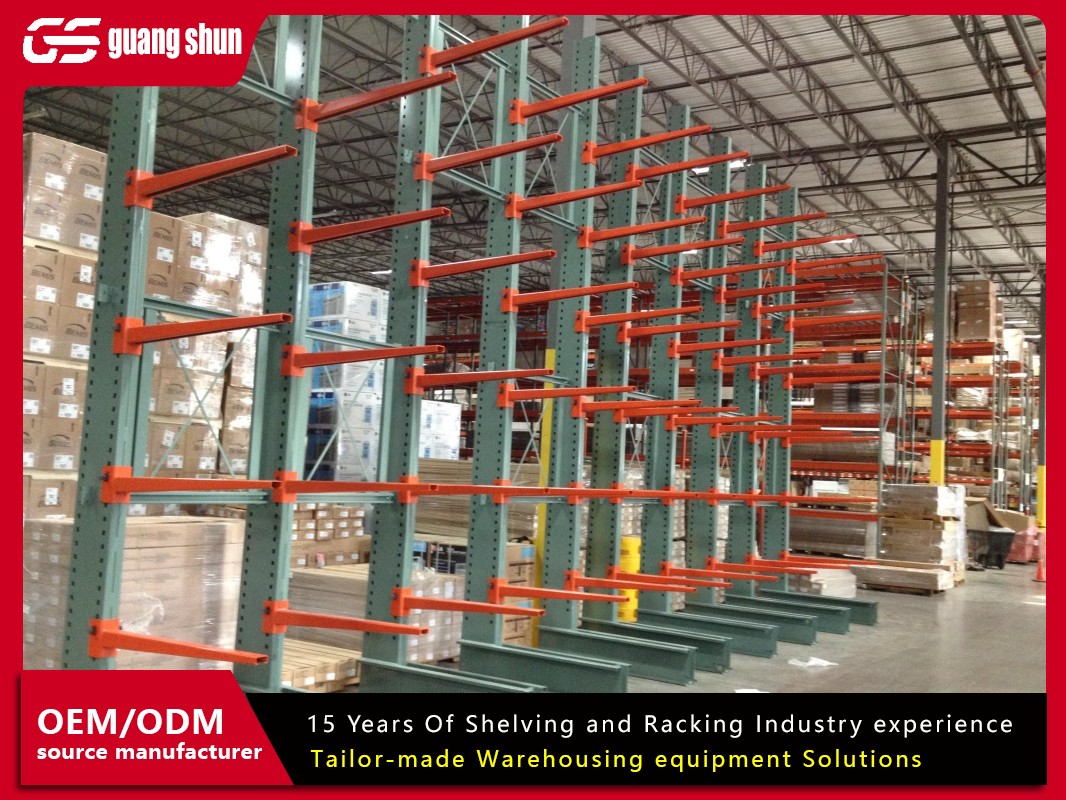
Fixed cantilever racking: Lower cost per arm, simpler
structure, but requires aisle space in front of every storage position. Access
is limited to what can be reached from the aisle face.
Swing arm shelves: Higher cost due to pivot mechanisms, but
allow denser storage. Arms can be swung aside to create temporary access paths
without permanent aisle allocation.
For operations storing multiple SKUs of long material in relatively low
volumes, swing arms often win on space utilization. For high-volume, single-SKU
storage, fixed cantilever systems usually deliver a better cost-per-tonne-stored
figure.
When the Swing Mechanism Justifies the Investment
Consider swing arm shelving when:
Floor space is constrained and aisle width cannot be dedicated to every
storage bay.
Stored items vary in length and must be accessed individually rather than in
full bundles.
Operators need to retrieve materials from multiple depths without a forklift
repositioning maneuver.
The inventory mix includes both long goods and shorter items that can share
the same vertical footprint.
Applications Across Industrial Sectors
Swing arm storage has moved well beyond its traditional role in metal service
centers. Current deployment patterns include:
Construction supply: Storing rebar, scaffold tubes, and
formwork components in yard or indoor racks where quick manual access is
required.
Plastics and extrusion: Holding PVC pipe, window profiles,
and custom extrusions that scratch easily and cannot be double-stacked.
Automotive aftermarket: Exhaust systems, drive shafts, and
body moldings that require damage-free handling.
Electrical contracting: Conduit, cable tray, and strut
channel in wholesale distribution centers.
Cold storage: Specialized galvanized or stainless
configurations for frozen food processing where long product handling is
necessary.
In each case, the swing action reduces handling time. A study of
order-picking workflows in a European metal distributor found that switching
from fixed cantilever to swing arm storage cut average retrieval time for long
goods by 22% and reduced product damage claims by 18%. The gains came from
eliminating the need to move front-stacked material to reach rear positions.
Installation, Safety, and Maintenance Standards
Swing arm shelves are structural systems. Installation quality directly
affects safety and service life. Key requirements include:
Floor flatness and load-bearing capacity: Concrete must be
level within the manufacturer's tolerance and thick enough to accept anchor
bolts without cracking.
Anchor specification: Mechanical or chemical anchors sized
for the calculated overturning moment, not simply the base plate hole
diameter.
Column plumbness: Vertical alignment within 1/500 of column
height is a common tolerance. Out-of-plumb columns cause uneven pivot wear.
Arm leveling: Each arm should sit level within 2 mm across
its length when loaded. Shimming may be required during installation.
Ongoing maintenance is minimal but not zero. A quarterly inspection should
check pivot bolt torque, bushing wear, weld condition at pivot plates, and base
anchor tightness. Any arm that develops lateral play exceeding 3–4 mm at the tip
should be taken out of service until the pivot assembly is rebuilt or
replaced.
For operations running multi-shift cycles, annual pivot lubrication and
bi-annual torque verification are recommended. Guangshun supplies swing arm systems
with documented maintenance schedules and replacement pivot kits to support
long-term reliability.
Selection Checklist for Procurement Teams
Before issuing a purchase order for swing arm shelving, gather the following
information:
Longest and shortest item dimensions to be stored.
Maximum weight per item and total weight per arm position.
Required number of storage levels and clear height between arms.
Available floor area and ceiling height.
Access equipment used (manual pick, reach truck, order picker).
Environmental conditions (indoor, outdoor, wash-down, cold store).
Required finish (powder coat, hot-dip galvanized, stainless).
Expected annual throughput and SKU count.
Suppliers who ask for these details before quoting are more likely to deliver
a system that performs as expected. Those who quote from a catalog without load
calculations are a risk.
Frequently Asked Questions
Q1: What is the typical lead time for a custom swing arm shelf
system?
A1: For standard configurations, lead time is usually 4–6 weeks from drawing
approval. Custom pivot assemblies, galvanized finishes, or multi-level designs
can extend this to 8–12 weeks. Domestic manufacturers with in-house fabrication
typically quote shorter timelines than import-based suppliers.
Q2: Can swing arm shelves be used outdoors?
A2: Yes, provided the finish is specified for exterior exposure. Hot-dip
galvanizing after fabrication is the standard recommendation for outdoor use.
Powder-coated systems will degrade within 2–3 years in UV and moisture exposure
unless a suitable exterior-grade coating is applied.
Q3: How much aisle space do swing arm shelves require?
A3: A minimum of 600–900 mm clearance in front of the rack face allows arms
to swing freely. If a forklift or reach truck operates in the same aisle,
increase clearance to 2,500–3,500 mm depending on equipment width and turning
radius. The advantage of swing arms is that this aisle can serve multiple
storage bays rather than one.
Q4: Are swing arm shelves compatible with automated storage
systems?
A4: Generally, no. The pivoting action is designed for manual or semi-manual
access. Automated storage and retrieval systems (AS/RS) require fixed, precise
pick faces. For high-throughput long-goods storage, a vertical lift module or a
specialized automated cantilever system is more appropriate.
Q5: What is the difference between single-sided and double-sided
swing arm shelves?
A5: Single-sided units have arms extending from one face of the column and
are placed against a wall or in a back-to-back row. Double-sided units have arms
on both faces of a shared column line, allowing access from two aisles.
Double-sided configurations improve space efficiency but require careful load
balancing to avoid column torsion.
Q6: How do I calculate the number of arms required?
A6: Divide the total inventory volume by the volume per arm position, then
add 15–20% for operational flexibility. For example, if you store 120 bundles of
pipe and each arm holds 4 bundles, you need at least 30 arm positions, plus 6
buffer positions, totaling 36 arms. Distribute these across the required number
of columns and levels.
Selecting the right swing arm
shelves comes down to matching the pivot mechanism, load rating,
and configuration to the actual inventory profile. A system designed around real
data will outperform a generic catalog solution every time. For operations
planning a long-goods storage upgrade, working with a manufacturer that provides
load calculations, installation drawings, and documented pivot testing reduces
both capital risk and long-term maintenance cost. Guangshun has supplied swing arm and
cantilever storage systems across 30 countries, with engineering support from
initial layout through commissioning.