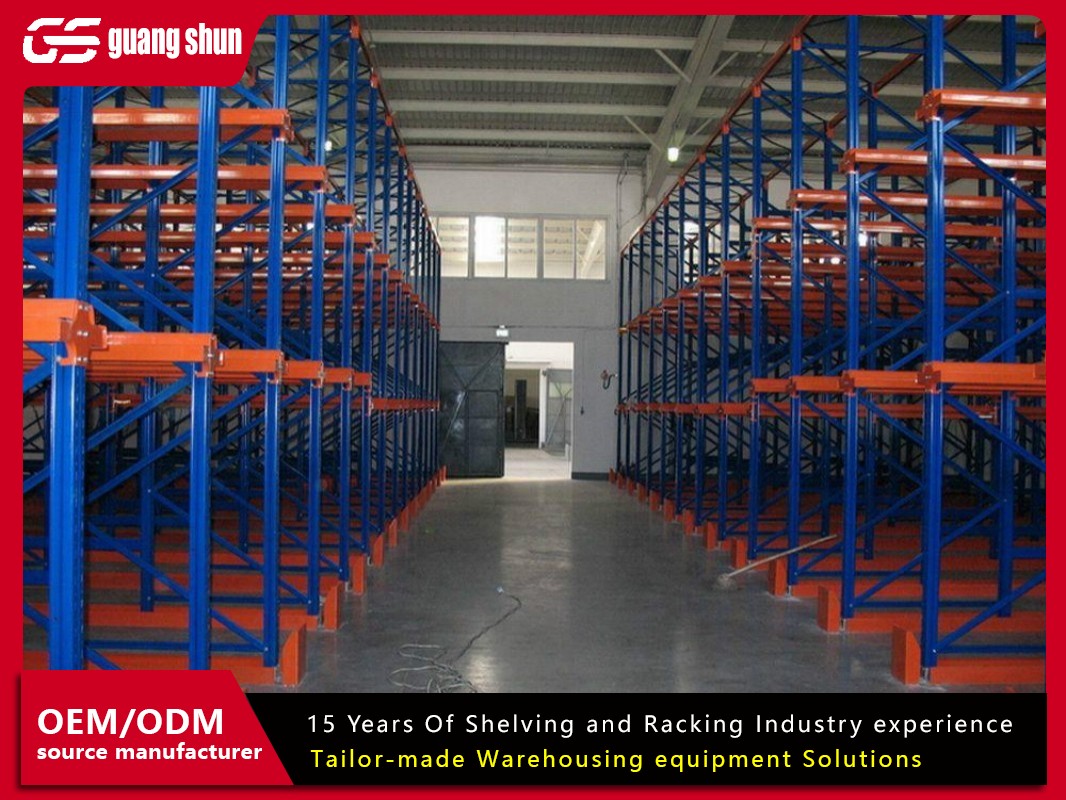
If you run a warehouse, distribution center, or any operation with a large amount of similar SKUs, you know the struggle. You need to store a lot of pallets, but you also need frequent access to all of them. Selective pallet racking wastes valuable floor space because every aisle takes up room that could be used for storage. Drive-in racks are dense but force you to operate on a strict "last-in, first-out" basis, which can cripple your inventory rotation.
There's a middle-ground solution that has become a cornerstone of modern warehouse design: the push-back rack system. It offers a compelling blend of high-density storage and good selectivity. Let's look at how this system works and why it might be the right upgrade for your facility.
How Push Back Rack Systems Actually Work
At first glance, a push-back rack structure looks similar to selective racking. You see upright frames and multiple load levels. The key difference is what's happening on each storage level.
Each level is made up of inclined rails, forming several independent storage lanes behind the face of the rack. Typically, each lane can hold 2 to 5 pallets deep. Specially designed carts, often called carriers or carriages, ride on these rails.
Here's the operational magic. When a forklift operator needs to store a loaded pallet, they drive into the lane at the front and simply push the new pallet into position. The force of the pallet pushes the existing pallets in that lane further back on their carts, rolling up the slight incline. It's a physical, kinetic system.
Retrieval is just as straightforward. The operator removes the front pallet. As soon as it's clear, the weight of the pallets behind causes the next cart in line to roll gently down the incline to the front position, ready for the next pick. This creates a dynamic, "last-in, first-out" (LIFO) flow within each individual lane.
The Core Advantage: Density Meets Selectivity
This simple mechanics translate into powerful warehouse benefits. The primary advantage of a push-back rack system is its space utilization. By storing pallets 2 to 5 deep, you dramatically reduce the number of aisles needed compared to selective racking.
You might only need one access aisle for every 6 to 10 pallet positions in depth, instead of one aisle for every single pallet. This can increase your storage capacity within the same footprint by 50% or more.
But unlike a pure drive-in system where the entire bay is one deep lane, push-back rack offers lane selectivity. You have multiple independent lanes at each level. This means you can store different products in the lanes right next to each other. Picking from Lane A doesn't disturb the inventory in Lane B or Lane C. This flexibility is crucial for operations with more than a handful of SKUs.
Where Push Back Racking Shines: Ideal Applications
Not every product is suited for this system. Knowing where it fits best is key to a successful installation. A push-back rack system excels in specific scenarios.
It is perfect for high-volume SKUs with medium to fast turnover. Think of beverages, packaged foods, paper products, or certain chemicals. You have a lot of one item, and you're constantly moving it in and out.
It's ideal for operations that can work with a LIFO inventory method within each product batch. If you receive a truckload of the same product, storing it in a push-back lane is efficient. You'll access the most recently received pallets first, which is often acceptable for non-perishable goods.
Operations with limited floor space that need to maximize every square foot will see an immediate benefit from the density of push-back racking. It's a common choice for warehouse expansion projects where adding a new building isn't an option.
What to Consider Before Investing in Push Back Racks
While powerful, this system isn't a universal fix. There are important practical considerations. First is the LIFO limitation. If you deal with perishable goods, pharmaceuticals, or any product with strict "first-in, first-out" (FIFO) requirements, a push-back rack is not suitable for those items. You would need a different system like pallet flow racking.
Forklift operator skill and patience are factors. Loading requires a smooth, steady push. Jerky movements can misalign the carts or damage pallets. The system also relies on uniform, stable, and high-quality pallets. Broken or irregular pallets will jam the lanes.
There is also a slight weight penalty. The carts and heavy-duty structure add weight and cost compared to standard selective racking. You are investing in mechanical components. Finally, consider your lane depth. While 5-deep lanes offer maximum density, they also mean a single pallet could be "buried" behind four others. For faster-moving goods, 2 or 3-deep lanes often provide the best balance of density and accessibility.
Comparing Push Back to Other High-Density Options
It's helpful to see where push-back rack fits in the wider landscape of dense storage. Compared to drive-in racking, push-back offers better selectivity and safety. Operators don't need to drive into the rack structure, reducing the risk of damage. Product rotation is similar (LIFO), but with multiple lanes per level.
Compared to pallet flow racking (FIFO), push-back is often less expensive per lane and can handle a wider range of pallet conditions and weights. However, it sacrifices the perfect FIFO rotation that flow racks provide through gravity.
Against selective racking, push-back wins on pure storage density in a given area but loses on 100% immediate access to every single pallet and the ability to practice perfect FIFO. The choice always comes down to your product mix, turnover, and operational philosophy.
Installation and Long-Term Maintenance Notes
Installing a push-back rack system is more complex than standard static racking. Precision is critical. The inclined rails must be perfectly aligned, and all carts must roll smoothly. This is almost always a job for professional installers who specialize in these systems.
Once operational, maintenance is relatively low but essential. The carts have wheel bearings that should be checked periodically. The rails need to be kept free of debris that could obstruct movement. A scheduled inspection for any structural damage or loose connections is a wise part of any warehouse safety program.
The good news is that these systems are built for industrial use. With proper care and trained operators, a quality push-back rack installation will provide reliable service for many years, paying back its initial investment through ongoing space savings and efficiency gains.
Making the Decision for Your Warehouse
Is a push-back rack system right for you? Start by analyzing your inventory. Group your products by turnover velocity and inventory rotation needs. If you have a significant portion of fast-moving, non-FIFO sensitive products stored on pallets, it's a strong candidate.
Calculate your potential space savings. A layout consultant or rack supplier can often provide a comparative analysis showing how many more pallets you could store in your existing building with push-back racking versus your current setup.
Finally, consider the throughput. Will the LIFO access within lanes slow your operators down, or will the reduced travel time from having fewer aisles speed them up? For many warehouses, the net effect is a significant gain in overall productivity.
By matching the system's strengths to your operational profile, you can determine if implementing push-back rack is the strategic move to unlock your warehouse's true capacity.
Frequently Asked Questions (FAQs)
Q1: What is the main difference between push-back and drive-in racking?
A1: The key difference is in operation and structure. With push-back racking, the forklift never enters the storage structure; it pushes pallets onto carts at the front. Drive-in racking requires the forklift to drive directly into the rack bay to place or retrieve a pallet. Push-back also offers multiple independent lanes per level, while a drive-in bay is one continuous, deep lane.
Q2: Is push-back racking more expensive than selective pallet rack?
A2: Yes, initially. A push-back rack system has a higher upfront cost per pallet position due to the added mechanical components like carts and inclined rails. However, the cost per square foot of building space is often lower because you can store many more pallets in the same area. The return on investment comes from maximizing your existing real estate.
Q3: How many pallets deep can a typical push-back rack lane be?
A3: Standard push-back rack systems are commonly designed for 2, 3, 4, or 5 pallets deep per lane. Three-deep is a very popular configuration as it offers a strong balance between high density and avoiding having any one pallet buried too far back. The specific depth is chosen based on your SKU velocity and inventory profile.
Q4: What kind of maintenance do the carts and rails require?
A4: Maintenance is minimal but important. Periodically, the wheel bearings on the carts should be inspected and lubricated according to the manufacturer's guidelines. The rails should be kept clean of dirt, plastic wrap, and debris that could hinder smooth rolling. A visual inspection for any bent components or cart misalignment should be part of routine warehouse checks.
Q5: Can I store different products in the same push-back rack bay?
A5: Absolutely, and this is a major advantage. Each vertical lane in a push-back rack system operates independently. You can store Product A in the first lane, Product B in the second lane, and Product C in the third lane—all on the same level. This allows you to consolidate multiple medium-volume SKUs in a single dense storage zone.