When storage density becomes the primary constraint in warehouse throughput,
conventional selective racking often forces operators to choose between
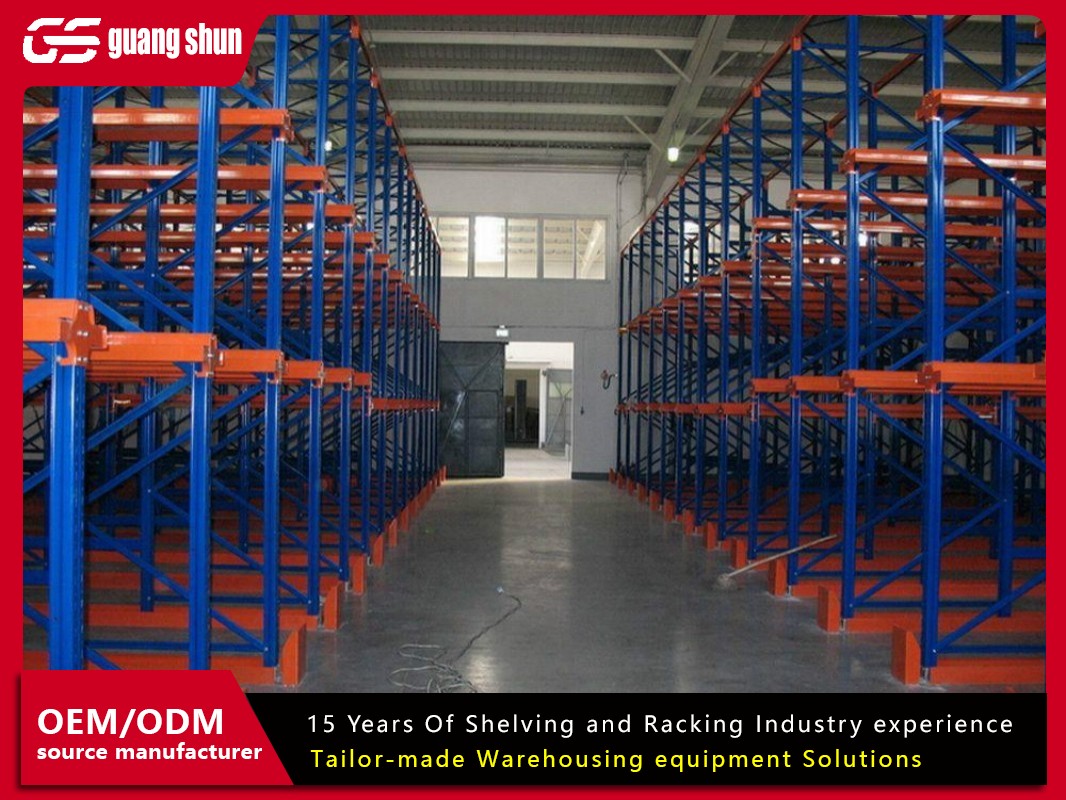
accessibility and cubic utilization. The einschubregal—commonly known as drive-in or
drive-through racking—eliminates this trade-off by converting aisles into
storage lanes. With lift trucks entering the rack structure directly, floor
space utilization frequently exceeds 75%, compared to 40–50% in selective
systems. This article examines the engineering principles, application-specific
configurations, and lifecycle economics of modern einschubregal installations,
drawing on validated performance data and structural standards. Specialists like
Guangshun have refined the design of these systems to
meet rigorous safety codes while maximizing pallet positions per square
meter.
1. Structural Anatomy of an Einschubregal: Beyond Simple Cantilevers
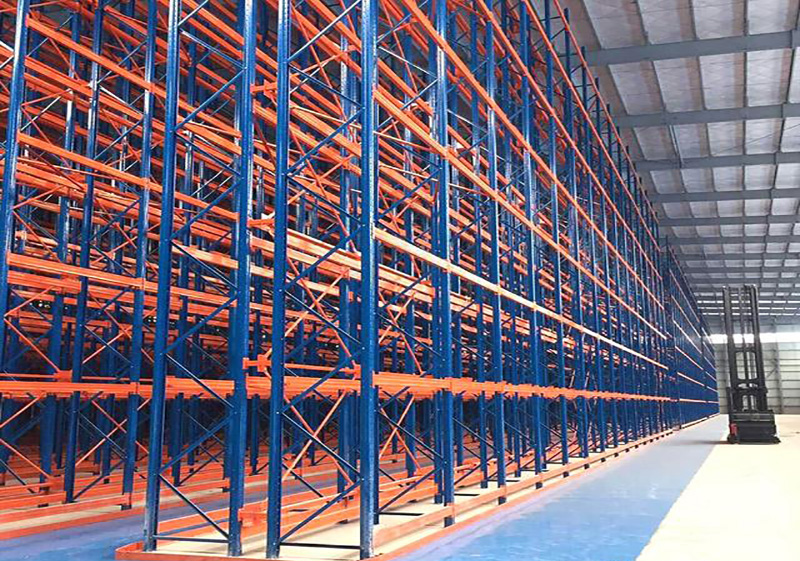
The performance of any einschubregal lies in its ability to support dynamic
fork truck loads while maintaining precise rail alignment. Unlike pallet racking
that relies on beams, drive-in structures use a system of upright frames,
horizontal rails, and lateral bracing to create continuous lanes.
1.1 Upright Frames and Column Profiles
Upright frames form the primary vertical supports. Typical sections range
from 100 mm × 80 mm to 150 mm × 120 mm, fabricated from cold-formed steel with
yield strengths of S350GD to S450GD. Frame spacing is dictated by pallet
dimensions and load weight—for standard EUR-pallets (1200×800 mm) with 1000 kg
loads, frame centers are commonly 2400–2700 mm. In seismic zones, additional
base plates and anchor bolts are designed to resist horizontal forces per EN
16681 or ASCE 7-16. A well-engineered einschubregal will incorporate slotted column
connections to allow for thermal expansion and minor structural adjustments
without compromising stability.
1.2 Rail Systems and Load Distribution
Continuous horizontal rails—usually 3.0–4.5 mm thick—support pallets along
the lane depth. Two design variants dominate:
Angle rail profile: Provides positive pallet positioning
and is preferred for uniform load dimensions.
Roll-formed box rail: Offers higher impact resistance and
is used for heavy loads (>1200 kg) or high forklift traffic.
Rails are attached to uprights via bolted connectors with vertical adjustment
slots, allowing ±5 mm leveling across the lane. Rail pitch (vertical spacing) is
calculated based on pallet height plus clearance—typically 100–150 mm above the
pallet. Laser-alignment during installation ensures that maximum rail deviation
remains below 2 mm over 10 meters, preventing pallet hang-ups and product
damage.
1.3 Lateral Stability and Safety Integrations
Longitudinal bracing (cross-ties and diagonal braces) is mandatory for rows
exceeding 20 meters in length or with more than three bays. End-of-aisle
barriers, column protectors, and integrated wire decking or mesh panels prevent
accidental load displacement. Fire safety is addressed via dedicated sprinkler
zoning; NFPA 13 requires specific clearance between stored goods and sprinkler
heads, which influences maximum storage height. Many modern einschubregal
systems incorporate smoke extraction pathways within the structure.
2. Application-Specific Configurations: FIFO, LIFO, and Environmental
Adaptation
The operational logic of an einschubregal is defined by lane depth and inventory
rotation strategy. These parameters are not arbitrary—they must align with
product shelf life, turnover frequency, and forklift fleet capabilities.
2.1 Drive-In vs. Drive-Through: LIFO vs. FIFO
In a drive-in configuration, the lift truck enters from one side, creating a
last-in, first-out (LIFO) flow. This suits non-perishable goods, batch storage,
and applications where product rotation is not critical. Drive-through systems
allow entry from both sides, enabling first-in, first-out (FIFO) flow—essential
for food, pharmaceuticals, and any product with expiration constraints. Typical
lane depths range from 2 to 8 pallet positions; deeper lanes (6–8) achieve
maximum density but require longer forklift travel time. A cost-benefit analysis
often shows that 4- to 6-pallet depth yields the optimal balance between density
and retrieval efficiency.
2.2 Cold Storage and Freezer Applications
Cold storage facilities (≤ -25°C) place extreme demands on steel structures
and coatings. An einschubregal designed for freezer environments must use
hot-dip galvanized steel (minimum 275 g/m² coating) or epoxy-polyester powder
coating to resist corrosion from condensation and repeated freeze-thaw cycles.
Rail connections must accommodate thermal contraction; oversized bolt holes or
slotted connectors prevent stress fractures. Additionally, aisle lighting and
forklift battery technology must be selected for low-temperature reliability.
Guangshun has executed projects where such cold-chain
drive-in racks achieved 20+ years of service with annual corrosion rates below
0.1 mm.
2.3 High-Bay Bulk Storage for Raw Materials
Manufacturing facilities storing raw materials—steel coils, plastic granules,
or heavy components—benefit from reinforced drive-in structures with additional
column bracing and larger footplates. Load capacities often exceed 2000 kg per
pallet position. Here, seismic calculations follow regional codes (e.g.,
Eurocode 8), and pendulum tests verify that the system can withstand horizontal
accelerations up to 0.3g without permanent deformation.
3. Addressing Core Industry Pain Points with Precision Engineering
Warehouse operators transitioning to einschubregal systems frequently cite four persistent
challenges—each solvable through design optimization and disciplined
installation.
Space underutilization: Traditional selective racking
dedicates 45–55% of floor area to aisles. Drive-in systems reduce aisle
proportion to 20–30%, increasing pallet positions per square meter by 50–100%
depending on lane depth. For a 5000 m² warehouse, this translates to an
additional 1200–2000 pallet positions without expanding footprint.
Forklift operational inefficiency: Deep-lane storage
increases average travel distance per pallet. However, with optimized lane
assignment (class-based storage) and pre-sequencing of retrieval orders, travel
time can be contained to a 15–25% increase versus selective racking, while
density gains outweigh this factor. Some operations integrate RFID guidance
systems to reduce entry time by 30%.
Product damage risks: Incorrect rail alignment or
inadequate impact protection causes pallet misalignment and structural damage.
The industry standard prescribes column guards at every exposed upright and a
minimum rail offset from column faces of 25 mm. Regular inspections per FEM
10.2.08 detect rail deflection exceeding 3 mm, enabling corrective action before
structural degradation occurs.
Inventory rotation compliance: For FIFO-required goods,
implementing drive-through lanes or combining drive-in blocks with a separate
forward-pick area resolves the LIFO limitation. A common hybrid approach uses
drive-in racks for bulk reserve storage and automated guided vehicles (AGVs) for
lane sequencing.
Leading suppliers like Guangshun utilize 3D
structural analysis software to simulate impact loads, thermal expansion, and
seismic events before fabrication, ensuring that each einschubregal meets both
operational KPIs and long-term safety margins.
4. Implementation Framework and Total Cost of Ownership
Deploying a high-density einschubregal system requires a methodical process
that integrates structural engineering, material flow analysis, and safety
certification. The following framework is derived from projects across
automotive, third-party logistics (3PL), and cold storage sectors.
4.1 Pre-Installation Site Assessment
Key data points include concrete floor flatness (F-number ≥ 40 for forklift
operations), anchor pull-out capacity (minimum 30 kN per column), and overhead
clearance for sprinklers and lighting. For retrofits, a load test of the
existing slab determines whether reinforcement is necessary. Scanning for
embedded utilities prevents drilling conflicts.
4.2 Tolerances, Assembly, and Certification
Erection follows EN 15620 or RMI MH16-1 specifications. Column plumbness
tolerance is ±10 mm over total height; rail alignment across a lane must not
exceed ±5 mm from the theoretical centerline. After assembly, a load test with
125% of rated capacity verifies structural integrity. Documentation includes
as-built drawings, torque records, and seismic compliance certificates where
applicable.
4.3 Total Cost of Ownership Analysis
While capital expenditure for an einschubregal is 15–30% higher than
selective racking on a per-position basis, the TCO picture often favors drive-in
when space is constrained. Factors:
Avoided expansion costs: Typical warehouse construction
costs €1200–€2000/m². Gaining 1500 additional pallet positions within the same
footprint avoids €500,000–€800,000 in building costs.
Maintenance expenditure: Annual inspection and minor
repairs average 1.5–2.5% of initial rack cost, primarily focused on rail
straightening and column protection replacement.
Energy savings: In cold storage, the smaller floor area due
to high-density storage reduces refrigeration volume by 15–25%, yielding
permanent operational savings.
Real-world case studies show payback periods ranging from 2.8 to 4.2 years
for well-designed einschubregal installations, with internal rates of return
(IRR) exceeding 18%.
5. Evolution: Integrating Automation with Drive-In Structures
The classical forklift-dependent einschubregal is now being augmented with
semi-automated solutions. Pallet shuttles—battery-powered devices that travel
within lanes—eliminate forklift entry altogether, reducing product damage by up
to 90% and allowing lane depths of 12–20 pallets. These shuttle-compatible
drive-in racks incorporate slightly wider rails and alignment guides.
Furthermore, warehouse execution systems (WES) can assign shuttle tasks to
balance inventory rotation and energy consumption. Hybrid designs retain the
structural principles of traditional einschubregal while adding scalability for future
automation upgrades—a strategy increasingly adopted by 3PLs anticipating
growth.
Digital twin technology now allows operators to simulate traffic flow, cycle
times, and energy use before committing to a configuration. For a recent
8,000-pallet-position project, simulation reduced average retrieval time by 22%
by optimizing lane assignment algorithms without any physical
reconfiguration.
Frequently Asked Questions (FAQ)
Q1: What is the maximum practical lane depth for an
einschubregal system?
For forklift-operated drive-in racking, maximum lane depth is typically 8
pallet positions due to visibility and exhaust constraints (for internal
combustion trucks). When using battery-powered pallet shuttles, lane depths can
extend to 12–20 positions, as the shuttle handles internal movement. Beyond 8
positions with standard forklifts, cycle times increase non-linearly, and damage
risk rises. A thorough simulation using discrete event modeling is recommended
to define the optimal depth for your specific throughput
requirements.
Q2: Can drive-in racking be installed in existing buildings
with low ceilings?
Yes, but the efficiency gains are proportional to building height. For
ceilings under 6 meters, the density advantage of drive-in systems is less
pronounced because vertical space is limited. However, even in facilities with
5–6 m clear height, drive-in racking can increase floor utilization by 30–40%
compared to selective racking. When ceiling height exceeds 10 m, double-deep or
triple-deep configurations with specialized reach trucks become feasible,
maximizing both floor and vertical density.
Q3: What corrosion protection is required for einschubregal
used in cold storage or chemical environments?
For cold storage (≤ -20°C) and high-humidity environments, hot-dip
galvanizing per ISO 1461 (minimum 85 µm coating thickness) is the standard. For
aggressive chemical exposure (e.g., fertilizer warehouses, salt storage),
additional epoxy topcoats or stainless-steel fasteners are recommended.
Suppliers like Guangshun provide coating warranties of 10–15 years when the
environmental classification is correctly specified during design. Regular
wash-down procedures should be compatible with the coating system to avoid
premature degradation.
Q4: How do I ensure FIFO compliance when using drive-in
racks?
FIFO (first-in, first-out) requires drive-through lanes where forklifts load
from one side and retrieve from the opposite side. If the building layout does
not permit drive-through, a common alternative is to designate certain blocks
for FIFO using pallet shuttle systems with software-controlled retrieval
sequencing. Hybrid designs that combine drive-in bulk storage with a separate
forward pick area can also maintain FIFO at the order-picking level while using
LIFO for reserve storage of non-perishable goods.
Q5: What are the typical costs for structural modifications
to support drive-in racking?
Costs vary by floor condition and seismic zone. Basic anchor installation and
floor flatness correction range from €15–€30 per square meter. For reinforced
slabs (required when loads exceed 15,000 kg per upright cluster), additional
costs can be €80–€150 per column cluster. A comprehensive site audit with core
sampling is advised to avoid unexpected reinforcement expenses. These structural
investments typically represent 8–12% of the total project cost and are
essential for safety and warranty validity.
Engineering an einschubregal system
demands precision at every level—from rail alignment to seismic anchorage—and
the operational rewards are directly tied to that discipline. When configured
with accurate lane depth, environmental protection, and clear inventory rotation
logic, these high-density structures deliver measurable improvements in cost per
pallet stored. Guangshun combines
structural expertise with site-specific analysis to deliver drive-in
installations that maintain safety margins while achieving density targets that
conventional racking cannot match. As warehouses face relentless pressure to do
more within existing footprints, the einschubregal remains one of the most
effective tools for bridging storage capacity and operational agility.