In modern logistics, the margin between operational profit and loss often
hinges on storage density, retrieval speed, and inventory accuracy. Traditional
static shelving can no longer keep pace with SKU proliferation, same-day
delivery expectations, or labor market volatility. Automated racking —encompassing everything from
pallet shuttle systems to mini-load AS/RS—has moved from a competitive
differentiator to a fundamental infrastructure requirement. This article
dissects the technical anatomy, industry-specific deployments, and financial
justification of modern automated racking, drawing on real-world metrics and
engineering principles. Providers like Guangshun have demonstrated that when automated
racking is precisely matched to operational DNA, it delivers sustained ROI far
beyond simple labor reduction.
1. Technical Architecture of Automated Racking: Beyond Conventional
Storage
To appreciate the capabilities of automated racking, one must first understand its
layered architecture. Unlike manual racking, which relies on human-operated
forklifts and static beams, automated systems integrate mechanical handling,
structural engineering, and a hierarchical control software stack.
1.1 Load Handling Mechanisms: Shuttles, Stacker Cranes, and Robotics
The core distinction lies in the material handling technology:
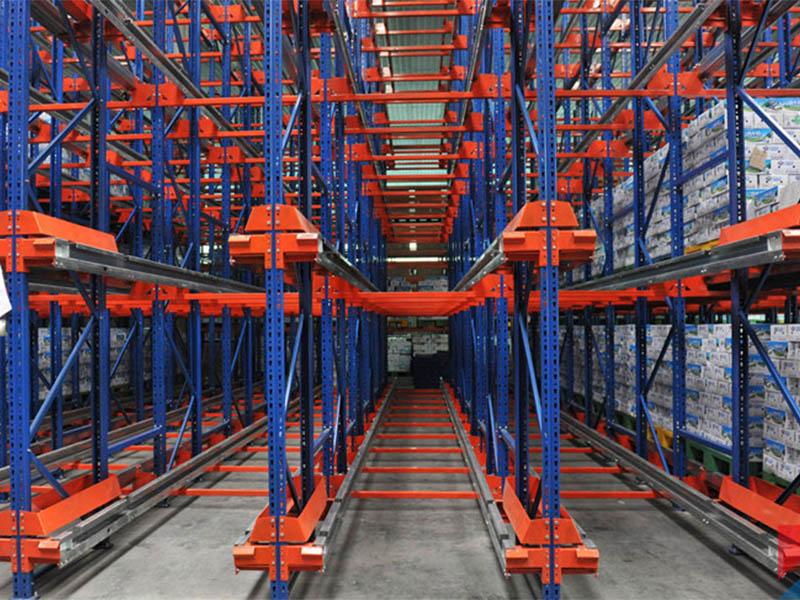
Pallet Shuttle Systems: Battery-powered, radio-controlled
shuttles operate within deep-lane racking, enabling FIFO or LIFO retrieval
without forklift entry. Typical throughput reaches 20–30 pallets per hour per
shuttle, with lane depths up to 40+ positions.
Unit-Load AS/RS (Stacker Cranes): These gantry-style cranes
use vertical masts and horizontal rails to serve tall racks (often exceeding 45
meters). They deliver 50–60 double cycles per hour per crane, ideal for high-bay
warehouses with uniform pallet loads.
Micro-Load & Mini-Load AS/RS: Designed for totes,
cartons, and smaller items, these systems achieve 200–250 cycles per hour and
integrate with goods-to-person workstations. They are the backbone of e-commerce
fulfillment.
Each mechanism interfaces with sensors (laser distance measurement,
photoelectric barriers) and encoders that ensure positioning accuracy within ±2
mm—a critical factor for damage prevention and system reliability.
1.2 Structural Components and Material Selection
Automated racking structures face unique stresses: dynamic loads from
high-speed shuttles, seismic forces, and continuous operation (often 24/7).
Automated racking frames
typically use cold-formed steel with higher yield strength (S350–S450 grade)
compared to static racks. Tolerances are stricter—column verticality within
1/1000—to ensure seamless shuttle or crane travel. Cold-chain environments
demand additional galvanization or epoxy coatings to resist corrosion from
condensation and cleaning chemicals.
1.3 Control Layer: From Sensors to WES Integration
Intelligence separates automated racking from mechanized storage. The control
architecture comprises:
PLC & Drives: Decode motion commands and safety
logic.
WCS (Warehouse Control System): Manages real-time device
orchestration, traffic management, and task prioritization.
WES (Warehouse Execution System): Bridges WMS and WCS,
adding labor management, wave optimization, and analytics. A robust WES can
increase system throughput by 15–25% without additional hardware.
Advanced implementations now embed IoT condition-monitoring sensors that
predict bearing wear or motor anomalies, slashing unplanned downtime by up to
60%.
2. Key Application Scenarios and Industry-Specific Demands
The versatility of automated racking allows tailoring to distinct
operational profiles. Below are three high-impact scenarios with quantifiable
outcomes.
2.1 E-commerce Fulfillment Centers: Throughput-Critical Environments
E-commerce DCs face SKU volatility, seasonal spikes, and sub-2-hour order
cutoff times. Micro-load AS/RS with multi-deep shuttle technology reduces travel
time by 70–80% compared to static shelving. In a recent deployment for a
European fashion retailer, a 5-aisle automated racking system (totaling 18,000
tote locations) increased picks per hour from 120 to 410 and reduced floor space
by 54%. The system’s ability to dynamically reassign inventory based on order
velocity (via WES algorithms) directly contributed to a 22% reduction in missed
SLA targets.
2.2 Cold Chain Storage: Reliability Under Extreme Conditions
Cold storage facilities face -25°C environments where human productivity
drops by 30–40% after 2-hour shifts. Automated racking eliminates continuous
human exposure. Pallet shuttle systems, equipped with low-temperature lubricants
and sealed electronics, maintain 100% throughput consistency. A North American
food distributor integrated a 12-deep automated shuttle rack with 6,500 pallet
positions, reducing energy consumption by 23% (due to narrower aisles and less
cold-air exchange) and eliminating 80% of forklift traffic, which cut
refrigeration load and product temperature deviations.
2.3 Manufacturing Just-in-Time (JIT) Line Feeding
Automotive and electronics manufacturers use automated racking for sequenced
line feeding. Vertical lift modules (VLMs) or mini-load AS/RS deliver parts to
kitting areas with 99.99% accuracy. One automotive supplier deployed a
automated racking system
integrated with their MES; component retrieval time dropped from 15 minutes to
90 seconds, and line-side inventory was reduced by 42%, freeing €1.2 million in
working capital.
3. Solving Critical Operational Pain Points with Automated Racking
Operational leaders adopt automated racking not for technology’s sake, but to
resolve four persistent pain points:
Labor scarcity & cost volatility: Warehousing labor
turnover rates average 30–40% annually. Automated racking reduces dependency on
non-strategic labor. A typical AS/RS installation reduces direct labor hours per
pallet by 60–75%.
Underutilized cubic space: Conventional racking uses only
20–35% of building cubic volume due to wide aisles and height constraints.
Automated racking can utilize spaces up to 40 meters high with aisle widths as
narrow as 900 mm, achieving volumetric utilization rates of 80–90%.
Inventory inaccuracy: Manual putaway and picking generate
error rates between 1–3%. Automated racking, combined with RFID or barcode
validation, drives cycle-count accuracy to 99.5% or higher, reducing write-offs
and mis-ships.
Energy inefficiency: Modern automated racking systems
incorporate regenerative drives in stacker cranes, recovering up to 30% of
braking energy. Narrow aisles also reduce the HVAC load—especially critical in
temperature-controlled warehouses.
Forward-thinking 3PLs and manufacturers rely on integrators like Guangshun to conduct pre-installation simulation that
models throughput, energy use, and labor impact, ensuring that the chosen
automated racking configuration solves these pain points with measurable
KPIs.
4. Implementation Roadmap and ROI Analysis
Transitioning to automated racking requires a phased, data-driven approach.
Below is the proven methodology used in successful deployments.
4.1 Site Assessment and Simulation
Every project starts with a granular analysis of SKU dimensions, order
profiles, peak throughput, and future growth. Discrete-event simulation models
the interaction between automated racking, conveyors, and human workstations.
For example, one simulation revealed that a 6-aisle automated shuttle system
would handle 108% of projected peak demand while a 5-aisle design would fail 12%
of the time. This level of precision prevents costly under- or
over-engineering.
4.2 Integration with Existing ERP/WMS
Automated racking is not a standalone island. API-based integration between
the WCS/WES and the host ERP/WMS ensures seamless inventory synchronization.
Middleware (like MuleSoft or proprietary connectors) translates between
real-time device events and business transactions. Without this layer, even the
fastest automated racking system
will fail to deliver system-level efficiency. The integration phase typically
accounts for 15–20% of total project time but dictates 80% of the realized
benefit.
4.3 Cost-Benefit Analysis: Real-World Metrics
A convincing ROI model for automated racking includes:
Capital expenditure: Hardware, controls, installation, and
commissioning (€/pallet position varies from €250 for simple shuttle lanes to
€1,200+ for mini-load AS/RS).
Labor savings: 3–7 full-time equivalents per shift
eliminated depending on throughput.
Space savings: Avoiding new construction (€1,500–€2,500/m²
saved) or freeing space for revenue-generating activities.
Accuracy & damage reduction: Typical 50–80% decrease in
product damage claims.
Real-world payback periods for automated racking projects range from 2.5 to 5
years, with internal rates of return (IRR) exceeding 20% for high-utilization
environments. Companies like Guangshun provide lifecycle
cost analysis that factors in maintenance, energy savings, and
scalability—ensuring the financial model withstands sensitivity tests.
5. The Future: AI-Driven Optimization and Adaptive Racking
The next frontier for automated racking lies in AI-driven orchestration.
Machine learning models now predict inventory velocity and dynamically relocate
SKUs within the rack to minimize travel time—a concept known as “heat-based
slotting.” Early adopters report 12–18% throughput gains without hardware
changes. Meanwhile, digital twin technology overlays real-time telemetry onto a
3D simulation, enabling predictive maintenance and what-if scenario analysis.
Adaptive racking structures, which use movable beams or convertible lanes, are
emerging to handle fluctuating SKU profiles, ensuring the system remains
optimized for 10+ years without structural overhauls.
Additionally, the convergence of automated racking with autonomous mobile
robots (AMRs) creates hybrid “goods-to-person plus robot-to-goods” workflows. In
this model, shuttles deliver bulk storage totes to a transfer station where AMRs
take them to multiple workstations, decoupling storage from picking and further
increasing scalability.
Frequently Asked Questions (FAQ)
Q1: What is the difference between automated racking and
traditional racking?
Traditional racking relies on forklifts or manual pallet jacks to access
stored goods, with aisles typically 3–4 meters wide. Automated racking
integrates mechanized systems—shuttles, stacker cranes, or robots—that operate
autonomously within narrow aisles (0.9–1.5 meters) and can extend to much
greater heights. This results in significantly higher storage density (often
2–3x more positions per square meter) and consistent throughput independent of
operator skill. Automation also enables 24/7 operation with real-time inventory
tracking integrated into the WMS.
Q2: How do I determine whether a pallet shuttle system or an
AS/RS stacker crane is right for my operation?
The choice depends on throughput, SKU count, and building profile. Pallet
shuttle systems excel in high-density, lower-throughput applications (e.g., bulk
storage, block storage) with deep lanes and moderate cycle counts (20–40
pallets/hour/lane). Unit-load AS/RS (stacker cranes) is better suited for
high-throughput operations requiring random access to thousands of SKUs,
achieving 50–60 cycles/hour per aisle. A hybrid approach is also common: using
shuttles for reserve storage and AS/RS for fast-moving inventory. A professional
integrator like Guangshun typically performs a flow simulation to recommend the
optimal mix.
Q3: What are the typical maintenance requirements for
automated racking systems?
Preventive maintenance is critical. Shuttle systems require quarterly
inspections of drive wheels, battery contacts, and sensors; stacker cranes
demand semiannual rail alignment checks and wire rope inspections. Many
operators adopt a predictive maintenance strategy using vibration analysis and
thermal imaging, reducing downtime by up to 50%. Maintenance costs typically
represent 2–4% of the initial capital investment annually. Manufacturers like
Guangshun offer remote monitoring services that alert to anomalies before
failure occurs, preserving system availability above 98%.
Q4: Can automated racking be retrofitted into an existing
warehouse without major structural changes?
Yes, but feasibility depends on floor flatness, ceiling height, and column
spacing. For facilities with at least 8–10 meters clear height, automated
racking can be installed within existing footprints by replacing static racks
with narrow-aisle structures. For lower ceilings, vertical lift modules (VLMs)
or horizontal carousels offer automation without height requirements. A site
survey assesses load-bearing capacity—automated racking imposes concentrated
point loads that may require floor reinforcement. Many retrofits achieve a
payback period under 4 years due to avoided new-build
costs.
Q5: What ROI metrics should I use to justify an automated
racking investment?
A comprehensive ROI analysis includes direct labor reduction (hourly wages +
benefits + overtime), space savings expressed as avoided facility expansion
cost, accuracy-related cost savings (order corrections, returns processing), and
productivity gains (pallets or lines picked per hour). Use a net present value
(NPV) model with a 5- to 7-year horizon, applying a weighted average cost of
capital (WACC) as discount rate. Typical projects deliver NPV values of $1.5–3
million per 10,000 pallet positions. Additional intangible benefits—improved
safety, scalability, and employee retention—further strengthen the business
case.
Investing in automated racking is a strategic decision that reshapes the
entire supply chain’s agility. With engineering-driven design, seamless software
integration, and a clear focus on ROI, organizations can transform warehousing
from a cost center into a competitive weapon. Industry leaders such as
Guangshun provide not only the hardware but also the
analytics and lifecycle support necessary to ensure that the automated racking solution remains optimized for
evolving operational demands. By combining technical precision with commercial
pragmatism, the path to warehouse automation becomes both profitable and
sustainable.