Every warehouse manager eventually faces the same problem: the walls aren’t moving, but the inventory keeps growing. You look at your facility and wonder where you are going to put the next shipment. Expanding the building is expensive and moving is a logistical nightmare.
The answer often lies in how you utilize your existing cubic footage. Traditional shelving leaves too much air and too many aisles. This is where push back warehouse racking changes the equation. It allows you to store more pallets in the same footprint without sacrificing accessibility to different SKUs.
Unlike static systems where you need an aisle for every row, push back warehouse racking utilizes depth. It turns wasted aisle space into productive storage space. It is a high-density solution that strikes a perfect balance between selectivity and storage volume.
If you are looking to optimize your operations, you need to understand exactly how this system works and why it might be the right fit for your facility. Here are 8 key reasons why this storage method is superior for high-density applications, along with a deep dive into its mechanics.
1. significantly Increasing Storage Capacity
The most obvious benefit of push back warehouse racking is the immediate gain in pallet positions. In a standard selective rack setup, you are often limited to one pallet deep. This means roughly 50% of your floor space is consumed by aisles so forklifts can turn.
With push back warehouse racking, you can store pallets 2, 3, 4, 5, or even 6 deep. This drastically reduces the number of aisles required in the warehouse. By consolidating your storage, you can often double the amount of inventory you hold in a specific area.
This density is achieved because the system utilizes the vertical space and depth of the rack structure. You are trading air space for product space. For warehouses paying a premium for square footage, switching to push back warehouse racking is often far cheaper than leasing additional real estate.
2. improving Selectivity Compared to Drive-In Racks
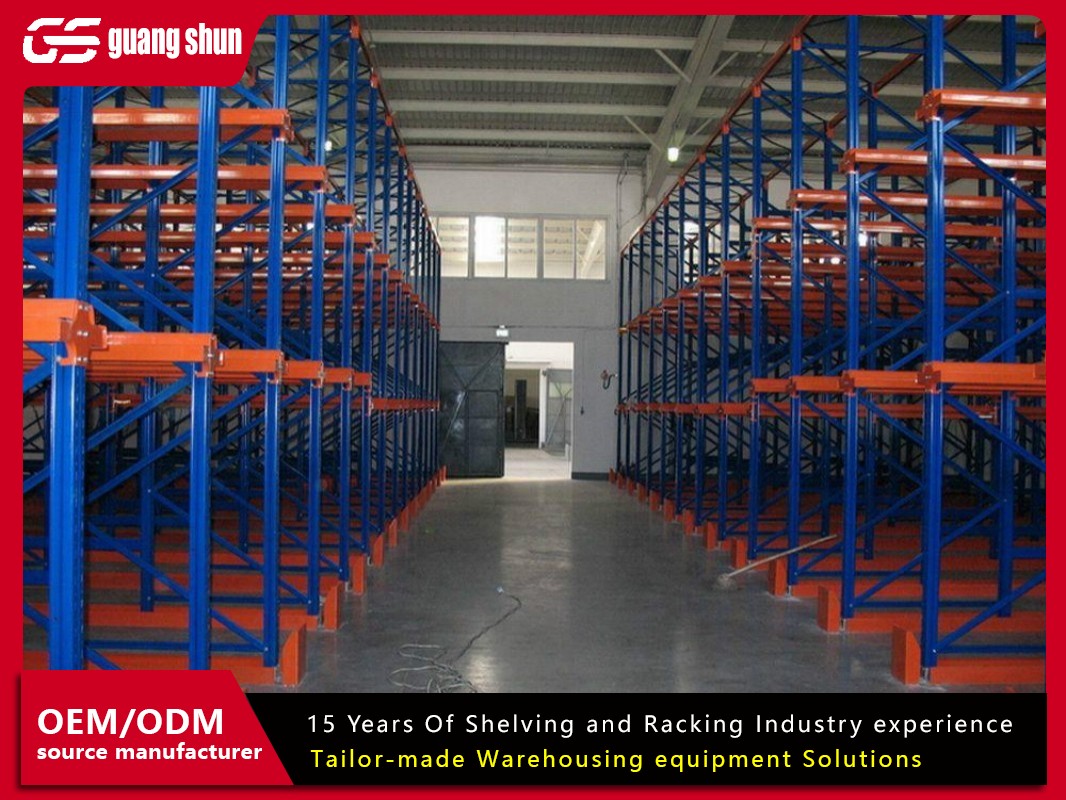
When people think of high density, they often think of Drive-In racking. While Drive-In systems are dense, they have a major flaw: poor selectivity. You bury your inventory deep in a tunnel, and you can’t get to the middle pallets without removing everything in front.
Push back warehouse racking offers a much better compromise. Each lane operates independently. You can have a different SKU in every single lane and on every level.
If you have a 4-level high system, you can store four different products in the same bay, accessed from the same aisle face. This "honeycombing" issue is much less severe with push back warehouse racking than with other high-density options. It allows you to store medium-turnover goods efficiently without burying them behind unrelated products.
3. The Mechanics of Nested Carts
To understand the reliability of the system, you have to look at the mechanics. Push back warehouse racking uses a system of nested carts that sit on inclined rails. These rails slope slightly toward the aisle face.
When the lane is empty, the carts sit stacked on top of each other at the front. When a forklift driver loads the first pallet, they place it on the top cart. When the second pallet arrives, the driver uses that pallet to push the first one back. The first pallet rolls back, exposing the second cart underneath.
This process repeats until the lane is full. The last pallet rests directly on the rails. When you remove a pallet, gravity takes over. The rear pallets gently roll forward to the front position. This automatic rotation is what makes push back warehouse racking so efficient for forklift operators.
4. Operational Speed and Efficiency
Time is the most expensive resource in logistics. In a Drive-In system, the driver has to carefully drive the forklift inside the rack structure. This is slow, dangerous, and requires high skill.
With push back warehouse racking, the forklift never enters the rack. The driver stays in the aisle. Loading and unloading are performed entirely at the rack face. This significantly speeds up the put-away and retrieval process.
Because the pallets flow forward automatically, the driver does not have to hunt for inventory or drive deep into a tunnel to fetch a load. This reduction in travel and maneuvering time means you can move more pallets per hour. Over the course of a year, the labor savings provided by push back warehouse racking can be substantial.
5. reducing Rack Damage and Maintenance
Forklift impact is the number one cause of rack failure. When drivers have to enter the racking structure, the risk of hitting an upright is high. Drive-In racks are notorious for suffering damage because the clearance is tight and drivers are under time pressure.
Since push back warehouse racking keeps the equipment in the aisle, the vertical uprights are much safer. The forklift forks only interact with the carts at the face of the system.
While you still need to protect your aisle-facing columns with guards, the internal structure remains untouched. This durability means your push back warehouse racking will likely have a longer lifespan and require fewer costly repairs compared to systems that require internal entry.
6. managing LIFO Inventory Effectively
It is important to note that push back warehouse racking is a Last-In, First-Out (LIFO) storage system. The last pallet you put in is the first one you take out.
For many industries, this is perfectly fine. If you move non-perishable goods, construction materials, or products with long shelf lives, LIFO is not a problem. Even for food products, if your turnover is fast enough (e.g., you clear a lane every week), LIFO is manageable.
This system is ideal for batch production. If you manufacture a batch of "Product A" today and fill three lanes, you will likely ship that batch out together. Push back warehouse racking supports this batch logic perfectly, keeping common SKUs grouped together in their specific lanes.
7. Versatility for Various Pallet Types
Many automated systems are very picky about pallet quality. If a pallet has a broken bottom board, it can jam a complex conveyor system. However, push back warehouse racking is relatively forgiving.
Because the pallets sit on carts rather than rolling directly on wheels (like in gravity flow racks), the condition of the bottom of the pallet is less critical. As long as the pallet is stable enough to sit on the cart, it will move.
This versatility allows push back warehouse racking to handle different pallet sizes and qualities within reasonable limits. Whether you are using standard GMA wooden pallets or plastic pallets, the cart system provides a stable platform that ensures consistent flow.
8. Safety Features and Color Coding
Safety is paramount in any heavy industrial setting. Modern push back warehouse racking systems come with built-in safety features to assist drivers.
The nested carts are often color-coded. For example, in a 4-deep system, the top cart might be red, the middle cart yellow, and the bottom cart green. This gives the forklift operator a visual indicator of how many pallets are hidden behind the front one.
Knowing exactly how full a lane is prevents errors during loading. Furthermore, because the pallets are controlled by the carts and rails, there is less risk of a pallet getting stuck or falling compared to simple stacking. Push back warehouse racking provides a structured, engineered environment for your heavy loads.
Comparing Costs and ROI
When you look at the price tag, push back warehouse racking is more expensive per pallet position than standard selective racking. It involves moving parts, rails, and carts. However, looking at the upfront cost alone is a mistake.
You must calculate the Cost Per Square Foot of your facility. By condensing your storage, you delay the need for building expansion. The ROI also comes from labor efficiency. If your drivers can pick 20% more pallets a day because they aren't driving into racks, the system pays for itself quickly.
Additionally, energy savings in cold storage environments are huge. If you run a freezer, you want to cool product, not air. Push back warehouse racking creates a dense thermal mass of product, which is much more efficient to cool than open aisles.
Installation Considerations
Installing push back warehouse racking requires precision. The rails must be installed with the correct vertical pitch (slope) to ensure the pallets roll forward gently but firmly. If the slope is too shallow, pallets get stuck. If it is too steep, they slam forward.
The floor of your warehouse must also be assessed. Because you are storing so much weight in a smaller footprint, the point loads on your concrete slab will be higher. A structural engineer should verify that your floor can handle the concentrated weight of a fully loaded push back warehouse racking system.
Ideal Applications
Where does this system shine the brightest? It is perfect for distribution centers that have a high volume of SKUs but also multiple pallets per SKU.
It is widely used in the food and beverage industry, automotive manufacturing, and third-party logistics (3PL). Any operation that needs to buffer inventory before shipping can benefit.
For example, a staging area near shipping docks is a great place for push back warehouse racking. You can load up orders rapidly and have them ready for the trucks, maximizing the speed of your outbound logistics.
Common Misconceptions
Some people believe that push back warehouse racking is prone to jamming. While mechanical issues can happen, they are rare with high-quality systems. The design of the carts usually includes debris guards to keep the wheels spinning freely.
Another misconception is that it is hard to learn. In reality, forklift drivers usually prefer push back warehouse racking over other high-density systems because it is easier to align the forks with the carts than it is to drive into a dark tunnel.
In the modern supply chain, efficiency is everything. You cannot afford to waste space or time. Push back warehouse racking offers a robust solution that solves the density problem without creating a bottleneck in selectivity.
It transforms your facility from a sprawling storage area into a compact, efficient machine. By understanding the flow of your inventory and the capabilities of your forklifts, you can leverage this system to significantly boost your operational output.
If you are dealing with space constraints, do not immediately look for a new building. Look at your racking. Upgrading to push back warehouse racking might be the smartest investment you can make for the future of your business.
Frequently Asked Questions (FAQ)
Q1: What is the maximum depth for push back warehouse racking lanes?
A1: While the most common configurations are 2, 3, 4, or 5 pallets deep, it is technically possible to go up to 6 pallets deep. However, as you go deeper, the force required to push the pallets back increases. Most facility managers find that 4 or 5 deep offers the best balance between density and ease of operation for standard forklifts.
Q2: Can I use different sized pallets in the same lane of push back warehouse racking?
A2: Generally, no. Each lane should be dedicated to a specific pallet size to ensure the load sits safely on the nested carts. While the carts provide a solid base, mixing vastly different pallet dimensions in one lane can lead to instability or "hang-ups" when the pallets flow forward. You can, however, design different lanes within the same system to handle different pallet sizes.
Q3: How much vertical space is lost with push back warehouse racking?
A3: Because the rails are sloped and the carts stack on top of each other, push back warehouse racking does require more vertical clearance between beam levels than selective rack. You typically lose about 6 to 8 inches of vertical height per level to accommodate the cart profile and the slope. This needs to be factored into your building’s clear height calculations.
Q4: Is push back warehouse racking suitable for fragile loads?
A4: Yes, but with caution. The system relies on the pallets rolling forward and coming to a stop at the front face. While the movement is controlled, there is a slight impact when the pallet hits the front stop. If your product is extremely fragile or unstable (like tall stacks of un-wrapped lightweight boxes), you need to ensure the pallets are wrapped very securely.
Q5: What maintenance is required for push back warehouse racking?
A5: Maintenance is relatively low but important. You need to keep the lanes free of debris, specifically wood chips or shrink wrap, which can jam the cart wheels. Routine inspections should check that the rails are not bent and that the carts move freely. Since the moving parts are protected within the rack, they don't suffer the same abuse as exposed components, but cleanliness is key to longevity.